

Every UK business planning an online store eventually arrives at the same fork: WooCommerce or Shopify. Both are excellent. Both power enormous slices of UK retail. And almost everything written comparing them is by someone with a financial stake in one answer.
Full disclosure: we build WooCommerce stores. We also tell roughly one in five ecommerce enquiries that Shopify is the better fit for them, because forcing the wrong platform onto a business is how agencies earn unhappy clients. So here is the comparison we walk prospects through, with 2026 UK pricing, verified against both platforms.
The Short Answer
Choose Shopify if you want a simple store live quickly with near-zero maintenance and your requirements fit inside its patterns. Choose WooCommerce if your products, pricing or operations have real complexity, if content and SEO drive your acquisition, or if you are building a long-term asset you fully own. Cost favours Shopify at small scale and WooCommerce as volume grows. The rest of this article is the evidence.
What Each Platform Actually Is
Shopify is a hosted platform: you rent your store. Hosting, security, updates and infrastructure are Shopify’s problem, which is genuinely valuable, and in exchange you accept its rules, its fees and its ceilings. WooCommerce is open-source software running on WordPress: you own your store outright, with total freedom over how it works, and in exchange the operational responsibility is yours or your agency’s.
By the numbers, WooCommerce leads the world on store count with 4.34 million live stores, around 33.4 percent of the market, against Shopify’s roughly 19.6 percent. Among the top 1 million highest-traffic stores the picture inverts: Shopify leads 28.8 percent to WooCommerce’s 18.2. Read those two statistics together and the market is telling you something true: hosted convenience wins at the big-brand end, ownership and flexibility win across the broad base of real businesses. The UK is WooCommerce’s second-largest market worldwide.
Head to Head
| Factor | WooCommerce | Shopify |
|---|---|---|
| Ownership | You own code, data and store outright | You rent; store lives on Shopify’s terms |
| Platform fees | None, ever | £19 to £259/month, plus 0.6 to 2% extra if you use a non-Shopify payment gateway |
| Card processing (UK, 2026) | Your provider’s rate, typically 1.4 to 2.9%; negotiable at volume | Shopify Payments: 2% + 25p (Basic), 1.7% + 25p (Grow), 1.5% + 25p (Advanced) |
| Setup speed | Weeks with an agency; days for a simple DIY build | Days; the genuine strength |
| Customisation | Unlimited; anything is buildable | Good within its patterns; checkout customisation gated behind Plus (~£1,800/month) |
| Content and SEO | Full WordPress: blogs, guides, landing pages, total URL and schema control | Workable blogging; less flexible URLs and content architecture |
| Maintenance | Yours: updates, backups, security (£150+/month or in-house time) | Included in the subscription |
| B2B, subscriptions, complex pricing | Native or near-native, full control | Possible via apps; deeper features gated to Plus |
| App/plugin costs | £200 to £800/year typical licence stack | £5 to £100+/month per app; stacks grow quietly |
| Exit costs | Portable; it is your database | Real migration project; URL and data constraints |
The Cost Comparison, Done Honestly
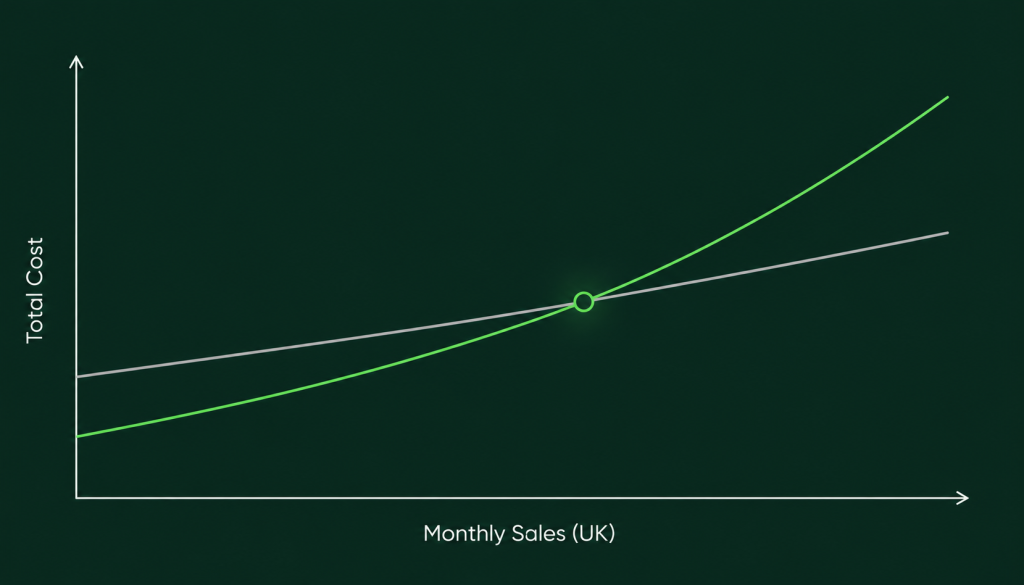
Headline prices mislead in both directions, so here is the arithmetic at three realistic UK volumes. Shopify assumptions: Grow plan at £49/month annual billing, Shopify Payments at 1.7% + 25p, a modest £60/month app stack (industry analyses of real UK stores put a typical Grow-plan store at around £260/month all-in at £5,000 monthly sales, so this is if anything generous). WooCommerce assumptions: £75/month quality hosting, £500/year licences, £200/month maintenance retainer, card processing at 1.5% + 20p, and a £10,000 custom build amortised over three years (£278/month).
| Monthly sales | Shopify, monthly all-in | WooCommerce, monthly all-in (incl. amortised build) | Advantage |
|---|---|---|---|
| £5,000 | ~£240 | ~£640 | Shopify, clearly |
| £25,000 | ~£600 | ~£950 | Shopify, narrowing |
| £80,000 | ~£1,570 | ~£1,790 | Near parity |
| £150,000 | ~£2,780 | ~£2,850, and falling once the build is amortised | WooCommerce from here on |
Three things the table cannot show. First, after year three the WooCommerce build cost drops out and the comparison swings hard toward ownership; percentage-based costs never amortise. Second, the Shopify column assumes your requirements stay inside standard plans; the moment you need checkout customisation or serious B2B, the relevant comparison becomes Shopify Plus at roughly £1,800 per month, and the arithmetic changes completely. Third, a cheaper WooCommerce starter build (£4,000 to £8,000) roughly halves the amortisation line, and plenty of UK retailers start there. Full build pricing is in our guide to WooCommerce development in London.
The fee nobody notices until it is large: if you use any payment provider other than Shopify Payments, Shopify charges an additional 0.6 to 2 percent on every transaction on top of your provider’s fees. WooCommerce has no equivalent. For businesses with negotiated merchant rates or specific gateway needs, this single line item can decide the platform.
The Hidden Costs on Each Side
Both platforms have costs their advocates leave out, so here are both lists. On Shopify: the app stack creeps (each app is £5 to £100 per month, and real UK stores commonly run 5 to 10 of them); premium themes cost £150 to £350 upfront; monthly billing runs about 25 percent above the advertised annual rates; email hosting is not included; and the third-party gateway surcharge catches anyone with an existing merchant account. Industry breakdowns of real trading stores put the “£49 plan” at around £260 per month all-in once a store is actually selling.
On WooCommerce: the build cost is real money upfront rather than a subscription; maintenance is not optional and skipping it is how stores get compromised; plugin licences renew annually and should be registered to you, never your agency; and a bad initial build creates costs no table can capture. The WooCommerce risks are concentrated at the start and controllable through who you hire. The Shopify costs are smaller, permanent and scale with success. Neither is wrong; they are different shapes of the same total, and which shape suits you depends on cash flow as much as preference.
When Shopify Is the Right Answer
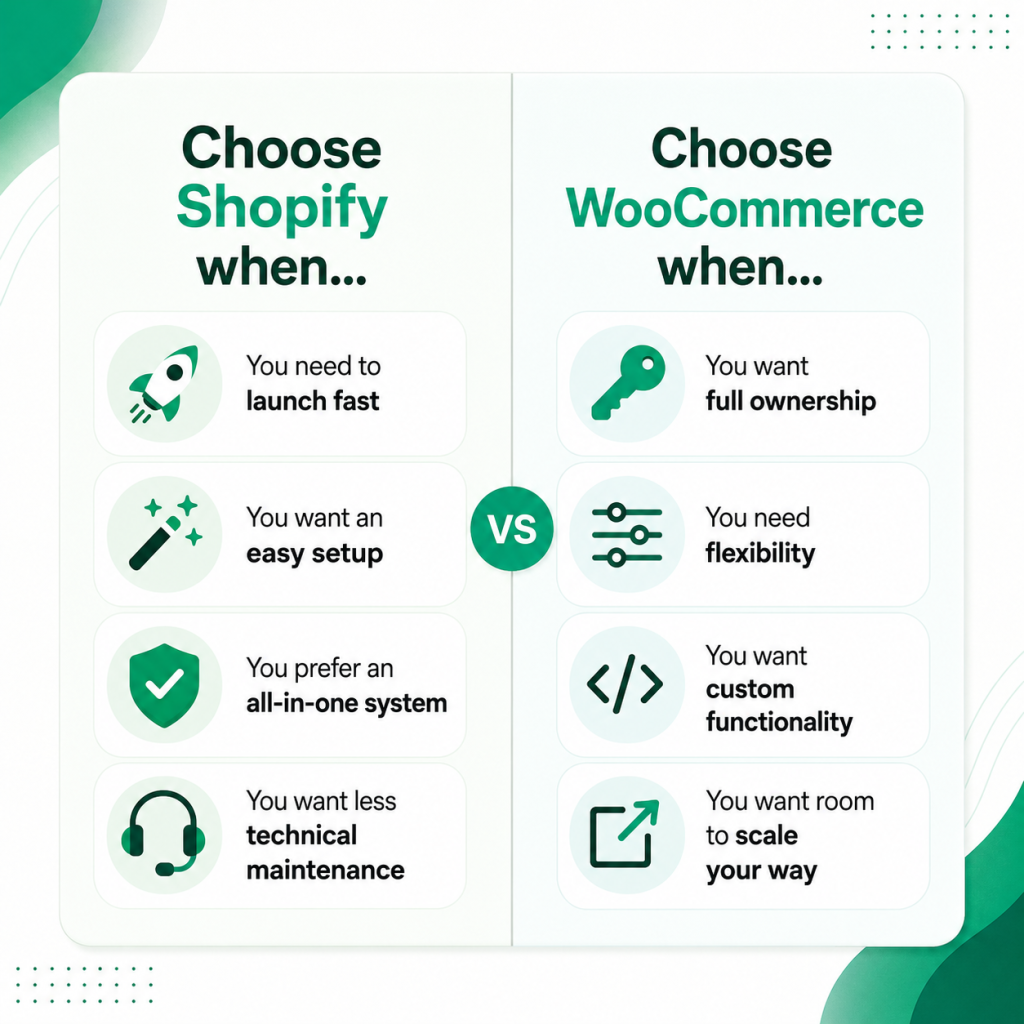
- You need to be trading in days, not weeks. Validating a product, spinning up a brand, moving fast. Nothing launches simpler.
- Nobody will maintain the store. No technical staff, no agency retainer, no appetite for updates. Shopify’s subscription buys you out of that entire job, and that is worth real money.
- Your catalogue and logic are genuinely standard. Straightforward products, standard checkout, no unusual pricing. Inside its patterns, Shopify is superb.
- Predictable costs matter more than lowest costs. One subscription line, few surprises. Finance teams like it for a reason.
When WooCommerce Is the Right Answer
- Your business has edges templates fight. Trade pricing, configurable products, deposits, restricted purchasing, unusual fulfilment. On WooCommerce these are engineering tasks; on Shopify they are workarounds or Plus-tier features.
- Content drives your acquisition. If guides, comparison pages and SEO are how customers find you, running the store inside WordPress is a structural advantage no app recreates. It is a large part of why the UK became WooCommerce’s second-biggest market.
- Volume is the plan. No platform fee and negotiable processing rates mean your costs flatten as revenue grows instead of scaling with it.
- You are building an asset. Own the code, the data and the customer relationships. Nobody can reprice your own store underneath you.
- B2B sits alongside B2C. Account pricing, quotes and credit terms without an enterprise-tier gate.
Our Recommendation
The content standard for this article requires an explicit recommendation, so here it is. For a simple store under roughly £10,000 per month in sales with no technical support and standard requirements: choose Shopify, and choose it without guilt. For an established or ambitious UK retailer with complexity, a content-led strategy, or £25,000+ monthly revenue in the plan: choose WooCommerce, budget properly for the build and maintenance, and treat the store as the asset it is. And if you are on Shopify today feeling the fee pressure or the customisation ceiling: replatforming is a well-trodden path (products, customers and order history migrate cleanly with an SEO redirect map), and it typically adds £2,000 to £8,000 to a build. Our full walkthrough of platform choice, costs and setup for UK retail is in the complete guide to WooCommerce for UK retailers.
We review this comparison annually against current pricing. Last verified against Shopify’s UK pricing page: July 2026.
Frequently Asked Questions
Is WooCommerce cheaper than Shopify in the UK?
At low volume, no: a simple Shopify store at £5,000 monthly sales runs around £240 per month all-in, less than WooCommerce once you include a professional build. From roughly £80,000 per month the platforms reach parity, and beyond that WooCommerce becomes cheaper because it charges no platform fees and its build cost amortises while percentage fees never do.
What does Shopify cost in the UK in 2026?
UK plans run £19 (Basic), £49 (Grow) and £259 (Advanced) per month on annual billing, with monthly billing around 25 percent higher and Shopify Plus from roughly £1,800 per month. Shopify Payments card fees are 2% + 25p, 1.7% + 25p and 1.5% + 25p respectively, and using a third-party gateway adds a 0.6 to 2 percent platform surcharge.
Can I migrate from Shopify to WooCommerce?
Yes, and it is a well-established migration: products, customers and order history transfer cleanly with the right tooling, and an SEO redirect map preserves rankings. Budget £2,000 to £8,000 on top of the build depending on catalogue size, and never launch without the redirect map.
Which is better for SEO, WooCommerce or Shopify?
Both can rank well, but WooCommerce offers structurally more control: full URL architecture, unrestricted schema, and native WordPress content capabilities for the guides and landing pages that drive organic acquisition. For content-led retailers this is usually the deciding factor.
Still on the fence?
Send us your catalogue size, requirements and monthly volume. We will tell you which platform we would build on, even when the answer is not us, and quote it fixed within 48 hours.
Talk to our WooCommerce team- Shopify UK pricing page, verified July 2026; plan and Shopify Payments rates as published.
- Peak Digital, Shopify Pricing UK 2026: real all-in monthly costs for trading UK stores.
- Store Leads via PureThemes, live WooCommerce store counts, 2026.
- Cloudways, WooCommerce Statistics 2026: market share by store volume and top 1M comparison.
- W3Techs, ecommerce usage statistics, 2026.