From idea to live SaaS product — without the tech headaches.
We architect, build, and launch subscription platforms from MVP to market. Multi-tenant architecture, billing integration, user management — the full stack, handled.

The working SaaS development
One we built: BuiltUp.
Each numbered note marks a decision we made on the real site, not a feature list.
- MVP
- from £15,000
- Production platform
- from £30,000
- Typical timeline
- 10–16 weeks for an MVP
- You receive
- One workflow, done properly, then the platform around it
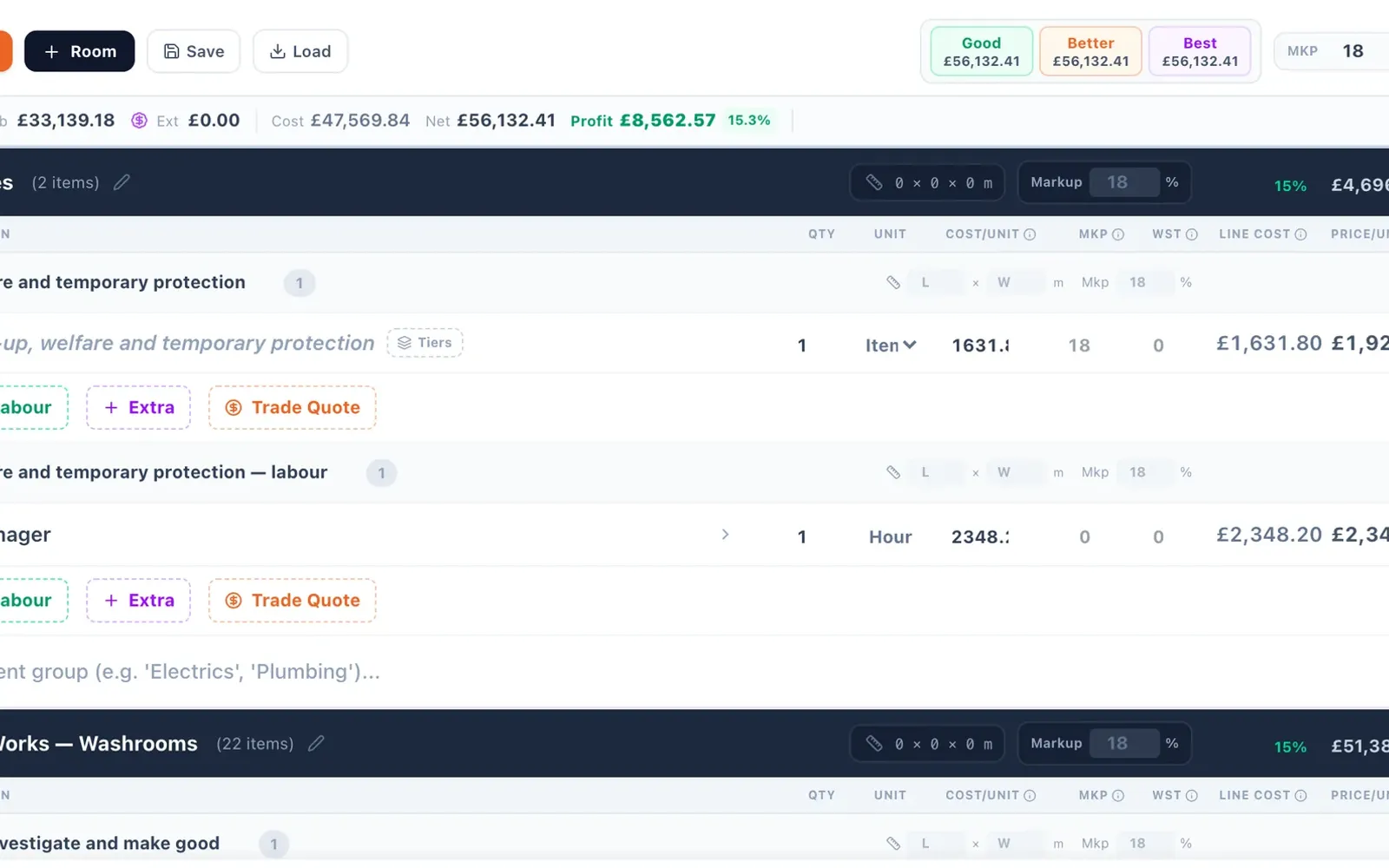
- 01Good, better and best options priced side by side on one estimate.
- 02Materials, labour, markup and profit visible on every line.
- 03One figure for preliminaries: we found the phone app at 17% and the web at 8%.
SaaS development that's engineered for revenue, not just releases.
Most agencies can build software. Very few understand the commercial mechanics of subscription products — pricing models, churn reduction, onboarding funnels, and the unit economics that determine whether your platform survives past Series A.
MVP in 8–12 Weeks
We ship validated MVPs fast — not throwaway prototypes, but production-grade foundations built on clean architecture that scale without a rewrite at Series A.
Multi-Tenant Architecture
Every platform we build is multi-tenant from day one. Shared infrastructure, isolated data, centralised billing — the architecture pattern that keeps your marginal cost per customer approaching zero.
Built for Recurring Revenue
Stripe-integrated subscription billing, usage-based pricing tiers, self-serve upgrades, dunning management — the revenue infrastructure that turns your software into a money machine.
Full-stack SaaS development from infrastructure to interface.
We don't just write code — we build the entire ecosystem your SaaS product needs to operate at scale. That means cloud infrastructure provisioned for elastic demand, CI/CD pipelines for zero-downtime deployments, and application architecture designed to evolve alongside your business model.
- Cloud-native infrastructure on AWS, Vercel, or Docker containers
- RESTful and GraphQL API architecture for third-party integrations
- Database design optimised for multi-tenancy and query performance
- Real-time features via WebSockets for collaborative workspaces
- Role-based access control and team management systems
From napkin sketch to paying customers in under 90 days.
Speed matters in SaaS — every week without paying customers is a week burning runway. Our MVP process is designed to get your core value proposition in front of real users as fast as possible, with just enough polish to charge for it and just enough infrastructure to learn from it.
- Lean validation sprints to identify your killer feature
- User onboarding flows engineered for activation and retention
- Stripe-integrated billing from day one — not bolted on later
- Analytics instrumentation to measure what matters before you scale
- Iterative post-launch sprints driven by real user behaviour data
The real work starts after launch.
Getting to market is step one. Growing from 100 users to 10,000 requires a different playbook — performance optimisation, conversion rate experiments, churn reduction systems, and infrastructure that auto-scales without your input. We stay in the trenches with you through every growth stage.
- Performance audits and database query optimisation at scale
- A/B testing on pricing, onboarding, and upgrade flows
- Automated dunning and failed payment recovery workflows
- Customer health scoring and churn prediction dashboards
- Feature flagging for controlled rollouts to user segments
Six phases from concept to scale.
Every SaaS engagement follows our battle-tested methodology — no shortcuts, no surprises.
Discovery
Business model analysis, competitive landscape, technical feasibility.
Architecture
System design, data modelling, API specification, infrastructure plan.
UX/UI Design
Wireframes, prototypes, design system, usability testing.
Sprint Build
2-week sprints, continuous integration, automated testing.
Launch
Staging review, performance audit, zero-downtime deployment.
Grow
Analytics review, conversion optimisation, feature iteration.
The decisions that are expensive to reverse.
A handful of choices made in the first fortnight determine whether your platform scales or gets rewritten. Almost none of them are about which framework you use, which is the decision teams spend the most time on.
Tenancy. Shared schema with a tenant column, schema per tenant, or database per tenant? Each has real consequences for cost, isolation, migration pain and what you can promise an enterprise buyer during security review. Retrofitting the wrong choice is close to a rewrite, and it is the mistake we most often get called in to unpick.
Identity and permissions. Roles look simple until the first customer asks for a user who can see two projects but edit only one. Building a real permissions model early costs a week; adding one to a live product costs months and touches every endpoint you have written.
Billing. Where subscription state lives, what happens on failed payment, how upgrades prorate, and whether usage is metered. Billing bugs are uniquely damaging because they are simultaneously a revenue problem and a trust problem.
Our guide, SaaS architecture for startups, covers this in full — and if you have not built one before, it is worth reading before you brief anybody, including us.
Cost follows the stage you are at.
The mistake we see most often is over-building at the first stage and under-building at the second. Indicative bands and timeframes are published on our MVP and product build page.
MVP
One workflow, done properly, in front of real users fast. Architected so the parts that are expensive to change are right, and everything else is deliberately disposable.
Production platform
Multi-tenancy, real permissions, billing, integrations, monitoring and the operational tooling you need once customers depend on it.
Scale & enterprise
SSO, audit logging, data residency, SLAs and the security posture enterprise procurement demands. Usually triggered by a deal you cannot close without it.
Architecture first, then speed.
The first fortnight is spent on decisions that are expensive to reverse. Everything after that is designed to be replaceable.
Discovery
The workflow that delivers the value, the users, and what has to be true for the product to work at all.
Architecture
Tenancy, identity, permissions and billing. The four decisions that are ruinous to change later.
Foundation
Repository, environments, CI, monitoring and deployment. Boring, and skipping it costs more than building it.
Core build
The one workflow, done properly, in front of real users as early as it can survive contact with them.
Iterate
Sprint cycles against real usage. Your first version is a hypothesis and it is usually partly wrong.
Scale
Multi-tenancy hardening, performance, SSO, audit logging and the security posture enterprise buyers require.
Where we help, and where we do not.
Platform engineering is expensive and slow to reverse, so it is worth being blunt about fit before anyone commits.
You are probably a good fit if:
- You have validated demand — customers, a waiting list, a manual process people already pay for — and need it built properly.
- You have a technical decision-maker, or you want us to be it, and that is agreed rather than ambiguous.
- You understand this is a continuing investment. A live platform needs engineering indefinitely; it does not reach a finished state.
- You want to own the code and the infrastructure, with no dependency on us to keep operating.
We are probably the wrong choice if:
- You are pre-validation. If nobody has paid or committed, build the cheapest possible test first. A no-code prototype or a manual service costs a fraction and answers the question faster.
- You need it in six weeks for a fixed low price. Something will be sacrificed, and it will be the architecture — which is the part that is ruinous to fix later.
- You want us to be your CTO permanently. We build and hand over. If you need a long-term technical leader, hire one; we will happily work alongside them.
- Equity instead of fees. We are a studio, not an investor.
If you are pre-validation, say so. We will tell you what we would build to test the idea cheaply, even though it is not work we would be doing.
Common questions about building SaaS with us.

Tell us what you're building. We'll tell you what it takes.
A free 30-minute call with the people who'd do the work. You leave with an honest view of scope, timeline and cost, whether or not you hire us.
- 65+ projects delivered
- 14+ years
- 6+ countries