
WooCommerce is the quiet giant of UK ecommerce. It does not advertise during the football and it does not send you a monthly platform bill that scales with your success, which is precisely why so many UK businesses run on it. But building a WooCommerce store that performs is a different discipline from building a WordPress site with a cart bolted on, and the difference shows up in your conversion rate, your page speed and your year-two costs.
This guide covers what WooCommerce development in London actually costs in 2026, how long a proper build takes, and what separates an ecommerce-capable agency from a generalist. It is written from our own store builds, including the unglamorous parts.
Why WooCommerce Still Dominates by Store Count
Store Leads tracked 4.34 million live WooCommerce stores in May 2026, and by store volume WooCommerce leads the global market at roughly 33.4 percent, ahead of Shopify at around 19.6 percent. The UK is its second-largest market worldwide after the US. The honest caveat, because you will hear it from any Shopify partner you speak to: among the top 1 million highest-traffic stores, Shopify leads with 28.8 percent against WooCommerce’s 18.2 percent. Big-brand ecommerce increasingly picks Shopify; the broad market of real UK businesses overwhelmingly picks WooCommerce.
The reasons hold up in practice. No per-transaction platform fees on top of payment processing. Full ownership of your data and code. Total flexibility on checkout, shipping logic and integrations. And it lives inside WordPress, so your content, SEO and store share one system. The trade-off is that this flexibility has to be engineered rather than rented, which is where development quality decides everything.
Not sure WooCommerce is right for you at all? We compared the platforms honestly in our guides to WordPress vs Webflow and the best payment processors for ecommerce. If you sell fewer than 20 products with simple logic and want zero maintenance, a hosted platform is a legitimate choice. For everything else, read on.
What WooCommerce Development Costs in London in 2026
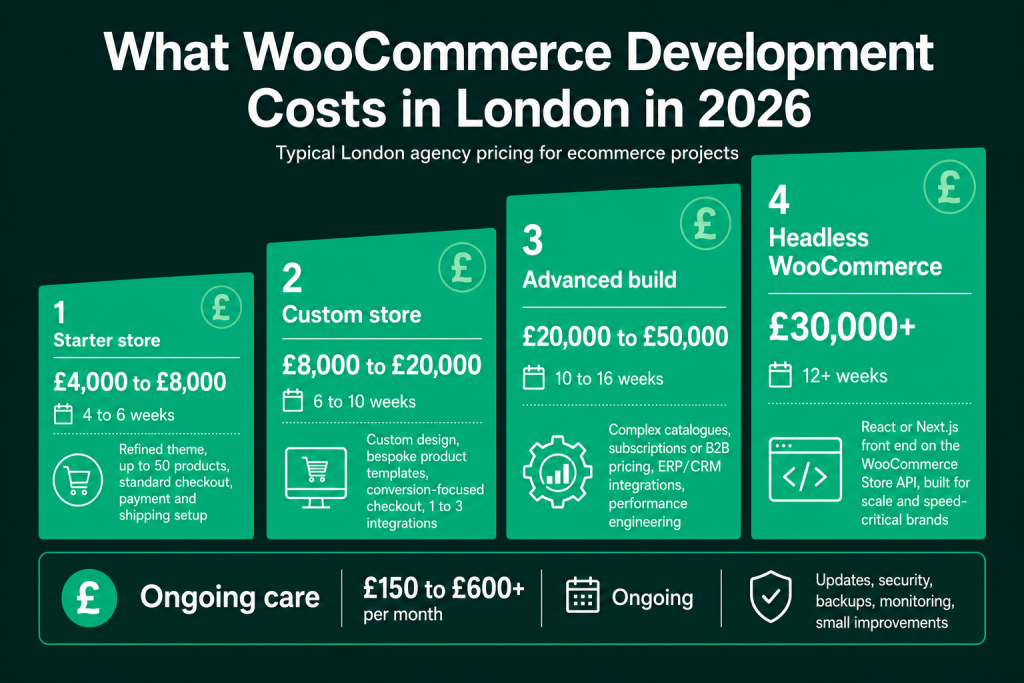
London agency rates for ecommerce work sit at the senior end of WordPress pricing, typically £85 to £150 per hour, because store work carries payment, security and testing overhead that brochure sites do not. Here is how that translates into project pricing.
| Project tier | Typical London cost | Timeline | What you get |
|---|---|---|---|
| Starter store | £4,000 to £8,000 | 4 to 6 weeks | Refined theme, up to ~50 products, standard checkout, core payment and shipping setup |
| Custom store | £8,000 to £20,000 | 6 to 10 weeks | Custom design, bespoke product templates, conversion-focused checkout, 1 to 3 integrations |
| Advanced build | £20,000 to £50,000 | 10 to 16 weeks | Complex catalogues, subscriptions or B2B pricing, ERP/CRM integrations, performance engineering |
| Headless WooCommerce | £30,000+ | 12+ weeks | React or Next.js front end on the WooCommerce Store API, for scale and speed-critical brands |
| Ongoing care | £150 to £600+ per month | Ongoing | Updates, security, backups, monitoring, small improvements |
Two cost notes worth knowing before you compare quotes. First, plugin licences are a real annual line item: a typical custom store carries £200 to £800 per year in premium extensions, and those licences should be registered to you, never to the agency. Second, hosting matters more for stores than for any other site type. Budget £30 to £150 per month for quality managed hosting; the £5 per month tier will cost you more in lost checkouts than it saves. For the wider pricing context, see our breakdown of what a WordPress website costs in London and current UK WordPress developer rates.
A Realistic WooCommerce Build Timeline
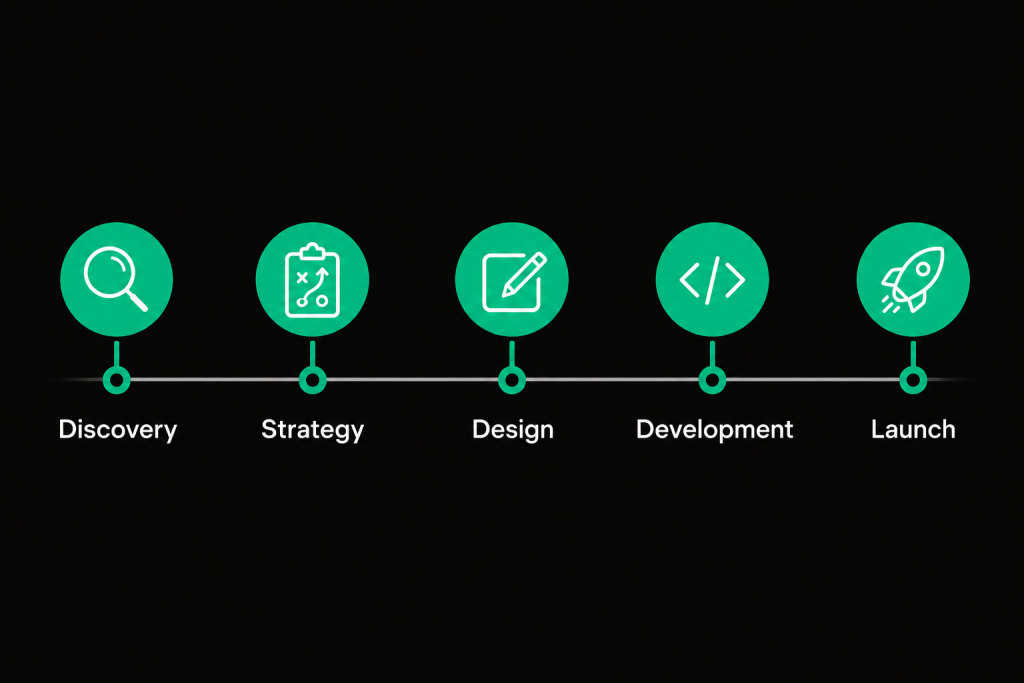
- Discovery and architecture (1 to 2 weeks). Product data modelling, shipping and tax logic, payment flows, integration mapping. Rushing this phase is the single most expensive mistake in store builds, because ecommerce logic is hard to change once live.
- Design (2 to 3 weeks). Product pages, category browsing, cart and checkout. Checkout gets designed first in our process, not last, because it is where the money is won or lost.
- Development (3 to 6 weeks). Theme build, WooCommerce configuration, custom functionality, integrations. A recent worked example from our own store projects: integrating ClickSend SMS alerts into WooCommerce.
- Testing (1 to 2 weeks). Full purchase paths on real devices, payment edge cases, refunds, tax scenarios, load testing if you expect campaign spikes. This phase is the clearest difference between agency and budget builds.
- Launch and stabilisation (1 week). DNS cutover, SSL, redirect map for SEO, analytics and conversion tracking verification, then a monitored first trading week.
The 2026 Technical Baseline Your Quote Should Include
WooCommerce has changed meaningfully in the last two years, and a store built to 2022 patterns is already legacy. Three items should appear in any competent 2026 proposal without you asking. High-Performance Order Storage (HPOS) should be enabled from day one, because it moves order data into dedicated tables and is the difference between a store that stays fast at 10,000 orders and one that grinds. The block-based checkout is now the modern standard and performs better than the legacy shortcode checkout it replaced, so a new build starting on the old checkout is starting behind. And if headless is on your roadmap, the WooCommerce Store API has matured to the point where a headless WordPress architecture is a planned upgrade path rather than a rebuild, provided the original store is structured for it.
None of these are exotic. They are simply the current baseline, and asking about them is a fast way to check whether an agency’s WooCommerce knowledge is current or secondhand.
What to Look For in a WooCommerce Agency
Every WordPress agency in London will say yes to a WooCommerce project. These five checks tell you who should be saying it.
- Live stores you can shop. Not screenshots. Place a test order on a store they built and pay attention to speed, mobile checkout and email confirmations.
- They talk about conversion, not just features. A store is a funnel. If the agency has no opinion on checkout friction, trust signals or page speed as revenue levers, they are building you a catalogue, not a shop.
- Performance numbers, in writing. Ask what Core Web Vitals targets they commit to on product pages. Slow stores lose sales measurably, and “we optimise for speed” is not a number.
- A security and update process. Stores handle personal and payment data, and WordPress sites in general are attacked constantly. Ask how updates are tested before deployment and what the backup and recovery plan is. Ongoing care structures are on our maintenance page.
- Honesty about when WooCommerce is wrong. The strongest signal of expertise is knowing the limits. An agency that has never recommended Shopify to anyone is selling a hammer, not a solution.
Migrating an existing store? Replatforming to WooCommerce from Shopify, Magento or an ageing custom cart adds data migration (products, customers, order history) and an SEO redirect map to the scope. Budget an extra £2,000 to £8,000 depending on catalogue size, and never let anyone launch without the redirect map. Our full checklist for vetting any agency, ecommerce or otherwise, is in our guide to choosing a WordPress agency in London.
Frequently Asked Questions
How much does WooCommerce development cost in London?
In 2026, a starter WooCommerce store from a London agency costs £4,000 to £8,000, a custom store £8,000 to £20,000, and advanced builds with subscriptions, B2B pricing or ERP integrations £20,000 to £50,000. Hourly rates for ecommerce work run £85 to £150.
How long does it take to build a WooCommerce store?
A starter store takes 4 to 6 weeks, a custom store 6 to 10 weeks, and complex or headless builds 12 to 16 weeks. Discovery and testing are the phases most often cut by budget providers, and the ones that most affect the result.
Is WooCommerce better than Shopify for UK businesses?
WooCommerce leads globally by store count at roughly 33.4 percent and gives you full ownership with no platform transaction fees, which suits businesses with custom requirements, content-led SEO strategies or cost sensitivity at scale. Shopify suits merchants who want a fully hosted, low-maintenance platform and accept its monthly fees and constraints.
What are the ongoing costs of a WooCommerce store?
Expect £30 to £150 per month for quality hosting, £200 to £800 per year in premium plugin licences, payment processing fees of roughly 1.4 to 2.9 percent per transaction, and £150 to £600+ per month for professional maintenance depending on store complexity.
Planning a store, or rescuing one?
Tell us your catalogue size, integrations and launch date, and we will send a fixed itemised quote within 48 hours. Bring us a struggling store and we will start with a free audit instead.
Explore our ecommerce development services- Store Leads, live WooCommerce store counts, May 2026 (via PureThemes WooCommerce Statistics 2026).
- Cloudways, WooCommerce Statistics 2026: platform market share by store volume and top 1 million comparison. cloudways.com/blog/woocommerce-statistics
- Colorlib, WooCommerce Statistics 2026: country distribution, UK second-largest market. colorlib.com/wp/woocommerce-statistics
- W3Techs, WooCommerce usage statistics, 2026. w3techs.com