
Search for a WordPress agency in London and you will find hundreds of firms with polished portfolios, five-star reviews and confident promises. From the outside they look interchangeable. From the inside, we can tell you they are not, and the differences that matter are almost never the ones on the homepage.
We are a London WordPress agency ourselves, so you should read this with that in mind. But we also inherit the aftermath when a selection goes wrong: sites nobody can update, licences the client never owned, builds that collapse at the first plugin update. These seven questions come directly from those post-mortems. Ask them before you sign anything, including with us.
Why WordPress Agencies Are So Hard to Compare
WordPress powers 41.9 percent of all websites according to W3Techs, which means the barrier to calling yourself a WordPress agency is essentially zero. The same phrase covers a firm that installs purchased themes and a firm that engineers custom platforms. Both can show you attractive screenshots, because screenshots do not show code quality, ownership terms or what happens in year two.
Price does not resolve the ambiguity either. A typical custom WordPress build at a London agency runs £5,000 to £25,000, and we have seen both excellent and terrible work at every point in that range. We publish our own numbers in our guide to how much a WordPress website costs in London, and we would encourage you to demand the same transparency from anyone you shortlist.
So the selection has to happen through questions. Here are the seven that separate builders from assemblers.
The 7 Questions to Ask Before You Sign
- “Will my site use a custom theme, a purchased theme, or a page builder, and why?” There is no universally wrong answer, but there is a wrong answer for your project. A £15k quote built on a £40 marketplace theme is a margin strategy, not an engineering decision. An agency that can articulate the trade-offs, as we did when we open-sourced our own Thorn starter theme, is showing you how they think.
- “Who owns everything when we part ways?” Code, hosting account, domain, plugin licences, analytics. The only acceptable answer is you, in writing, from day one. Agency-held licences are the most common lock-in we untangle for new clients.
- “Can I speak to a client from two years ago?” Fresh launches always look good. What you want to know is whether the site still updates cleanly, whether support requests get answered, and whether costs stayed as promised. Long relationships are the strongest signal in this industry, which is why our case studies include work we still maintain years later.
- “What is your process before design starts?” If the answer jumps straight to mood boards, be careful. Discovery, user research and measurable goals are what separate a redesign that performs from one that just looks different. We wrote about the wreckage of skipping this in why most website redesigns fail.
- “How do you handle performance and SEO at launch?” Ask specifically about Core Web Vitals targets, redirect mapping and structured data. A migration without an SEO plan can erase years of rankings in a weekend. Run any agency’s own site through our free SEO checker and performance audit tools. Agencies that do not maintain their own house rarely maintain yours.
- “What happens after launch?” WordPress sites face a security attack every 32 minutes on average according to WPZOOM’s 2026 statistics roundup, so updates, backups and monitoring are not optional extras. Ask for the support tiers and response times in writing. Ours are on our maintenance page.
- “What would you cut from my brief?” This is the fastest quality filter we know. An agency that agrees with everything is selling. An agency that pushes back on scope, suggests phasing, or tells you a feature will not earn its cost is planning to be accountable for the result.
A note on awards and directories. Listings on platforms like Clutch and DesignRush are useful shortlisting tools because the reviews are verified, but treat them as a starting point rather than a verdict. Synmek has been named a top UK web design and development company by DesignRush, and we would still tell you: read the actual review text, not the star count, and weigh recency heavily.
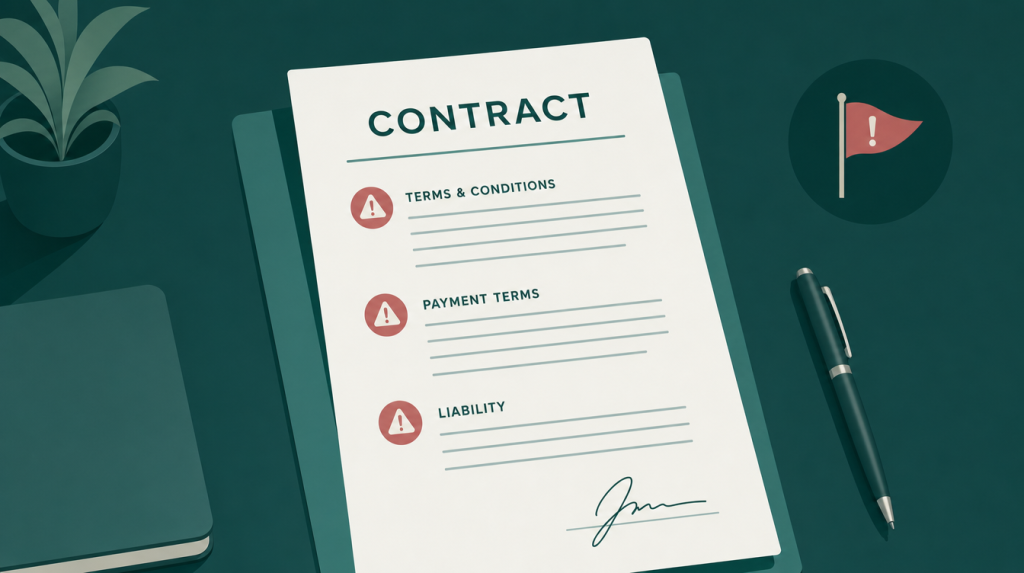
Red Flags That Should End the Conversation
Some signals are worth walking away from regardless of how good the portfolio looks. A quote produced without a single question about your business goals. Refusal to itemise what is included. Hosting you cannot access. A contract with no IP assignment clause. Guaranteed rankings, which nobody can honestly promise. And vagueness about who exactly will do the work, because “our team” sometimes means an undisclosed subcontractor on another continent, which matters for accountability and GDPR alike.
What a Good Proposal Actually Looks Like
Once the answers come back, the proposal itself is evidence. A serious WordPress agency proposal has five properties. It itemises scope by phase, so you can see what discovery, design, development and testing each cost rather than receiving one opaque number. It states its assumptions, such as how many page templates, how many revision rounds and who supplies content, because assumptions are where disputes are born. It lists exclusions explicitly, which feels negative but is actually the mark of a team that has been burned by ambiguity and learned from it. It ties payments to milestones you can verify, not to dates on a calendar. And it names the people who will do the work.
A proposal missing most of these is not automatically dishonest, but it does mean the difficult conversations have been deferred to mid-project, when you have the least leverage. Compare the three proposals on these properties before you compare them on price, and the price comparison usually resolves itself.
How to Run the Selection Process
Shortlist three agencies, no more. Send each the same one-page brief covering goals, audience, must-have functionality and budget range. Being open about budget does not weaken your negotiating position; it filters out mismatches before anyone wastes a week. Then put the seven questions above to each of them, ideally on a call where you can hear the hesitations.
Score what you hear against what your project actually needs. A brochure site for a consultancy has different requirements from a WooCommerce store or a publication, and the right agency for one is often wrong for another. If your project is design-led, weigh our WordPress design services style of questions more heavily. If it is engineering-led, lean on the development questions and look at how the agency’s WordPress developers talk about code, testing and handover. For the full evaluation framework beyond WordPress specifics, our 5-step checklist for choosing a web design agency in London pairs well with this article.
Frequently Asked Questions
How much does a WordPress agency in London charge?
London agency rates in 2026 typically run £75 to £150 per hour, with custom WordPress builds most commonly landing between £5,000 and £25,000 depending on design complexity, functionality and integrations. Ongoing maintenance is usually priced separately from £100 to £500+ per month.
What should I check before signing with a WordPress agency?
Confirm in writing that you own the code, hosting, domain and all licences; ask for a client reference from at least two years ago; review the discovery process, SEO migration plan and post-launch support terms; and check the agency’s own site performance.
Should I choose a specialist WordPress agency or a general web agency?
If your site will live on WordPress long term, a specialist team brings deeper knowledge of the plugin ecosystem, security practices and performance patterns. A general agency makes sense if you are genuinely undecided on platform and need that comparison made honestly first.
How long does a WordPress agency project take?
A typical custom WordPress build takes 6 to 12 weeks from kickoff to launch: roughly 2 weeks of discovery and planning, 2 to 4 weeks of design, 3 to 5 weeks of development and 1 week of testing and launch. Ecommerce and heavy integrations extend this.
Put us through the seven questions
We built this checklist knowing we would be measured against it. Book a call, ask us all seven, and get a fixed itemised quote within 48 hours.
See our WordPress agency services- W3Techs, Usage Statistics of Content Management Systems, July 2026. w3techs.com
- WPZOOM, WordPress Statistics, July 2026: security attack frequency. wpzoom.com/blog/wordpress-statistics
- DesignRush, Top Web Design Companies rankings. designrush.com
- Osdire, Web Developer Rates in the UK 2026: agency rate ranges.