
of redesigns fail to deliver
SoftwareReviews, 2023
fail due to misaligned goals
Forrester Research
extra sales cost from poor websites
SoftwareReviews, 2023
The Redesign Trap: Spending First, Thinking Second

Most businesses discover the failure of a website redesign the worst possible way: six months after launch, when organic traffic has dropped 30%, the bounce rate has climbed, and the sales team is asking why qualified leads have dried up. The redesign looked beautiful in the agency presentation. The new brand palette was approved enthusiastically in the boardroom. And yet, somewhere between the mockups and the live environment, the investment quietly unravelled.
This is not a rare story. According to research from SoftwareReviews, 80% of website redesigns fail to achieve their maximum potential, primarily because of a disconnect between what the business needs and what the design actually delivers (SoftwareReviews, 2023). The same research found that SaaS companies that fail to align their corporate website with buyer expectations spend an extra $113,000 per year on sales salaries simply to compensate for the leads their website should have generated.
That number tends to focus minds quickly.
The most common trigger for a website redesign is not a strategic one. According to GoodFirms, 80.8% of website redesign projects begin because of low conversion rates (GoodFirms, 2025). That makes intuitive sense. The website is not converting. The logical response is to change the website. What gets skipped, almost universally, is the question of why it is not converting.
Low conversion rates are a symptom. They are not a diagnosis. A website can convert poorly because the messaging does not resonate with the target audience. It can underperform because page load times are punishing user patience before anyone reads a single word. It might fail because the traffic arriving is the wrong traffic entirely, and no amount of design polish will change that. It might also convert poorly because the product itself has a positioning problem that no redesign can solve.
When a business goes straight to a design agency without answering those upstream questions, it is buying a new paint job for a car with a broken engine. The result looks different. The performance does not improve.
Synmek Perspective
The single most important conversation we have with a client before any design work begins is about what is actually broken. Design is often the last layer to address, not the first. If the strategic and structural problems are not solved before the creative brief is written, the redesign will inherit every one of them in a more expensive form.
The Four Real Reasons Redesigns Fail
After working across dozens of digital product builds and website projects, the same failure patterns appear with uncomfortable consistency. They are not mysterious. They are almost entirely avoidable, and they almost always trace back to decisions made before a single wireframe was drawn.
1. Aesthetics are treated as strategy
There is nothing wrong with wanting a website that looks good. Visual credibility matters enormously: research from Stanford University found that 75% of people form their judgement of a company’s credibility based on its website design (Stanford Web Credibility Research). But aesthetics and strategy are not the same thing, and conflating them is how companies end up with websites that win design awards and lose commercial ground.
McKinsey’s 2018 “Business Value of Design” study, which analysed more than 300 companies over five years, found that businesses with a strong design practice grew their revenues up to twice as fast as industry peers. Critically, the study defined strong design practice not as beautiful interfaces, but as user-centred, evidence-based decision-making embedded throughout the product development process. Aesthetics were a byproduct of that rigour, not a replacement for it.
2. Success is never defined before work begins
Ask the team commissioning a redesign what success looks like at the end of the project, and a depressing number will describe a feeling rather than a number. “We want it to feel more premium.” “It should look more modern.” These are not goals. They are preferences.
A redesign without measurable objectives has no way to fail, which means it also has no way to succeed. Before any creative brief is written, the team needs to define specific, measurable outcomes the project is accountable for: target conversion rate improvements, organic traffic benchmarks, Core Web Vitals scores, lead volume, or pipeline influence. Without those anchors, the project drifts toward what looks best in a presentation rather than what performs best in the market.
3. The existing users are not consulted
One of the most reliable ways to damage a well-performing website is to redesign it without understanding why users currently behave the way they do on it. Companies routinely discard high-converting page structures, effective navigation patterns, and trusted content in favour of something that feels more contemporary, without any data to support the change.
Snapchat’s 2018 redesign is the highest-profile example of this failure at scale. The interface launched without adequate user testing, the app’s rating dropped from 3.1 to 2.4 stars almost overnight, and ad revenue fell by 36% in the following quarter. The company spent the next two years partially reversing those changes. The redesign cost them not just money, but trust, and trust is considerably harder to rebuild than a UI.
4. SEO is treated as a post-launch concern
This is perhaps the most quietly expensive mistake on the list. A website migration that does not preserve URL structure, canonical tags, internal linking architecture, and page-level authority signals will destroy years of accumulated organic search equity in a matter of days. Google does not give the benefit of the doubt to redesigned websites. It re-evaluates them from scratch.
The correct approach is to run a full technical SEO audit before any structural decisions are made, map all existing URLs to their intended new equivalents, implement 301 redirects comprehensively on launch day, and monitor organic performance in real time during the post-launch period. This is not optional for any business where organic search is a meaningful source of traffic or leads. It is the minimum standard of care.
What Discovery Actually Means

The word “discovery” gets used a lot in agency pitches, and it has been diluted by overuse. In its proper form, discovery is the structured process of understanding what a business needs, what its users need, and where those two sets of needs diverge, before any creative or technical decisions are made. It is not a kickoff call. It is not a brief-filling exercise. Done properly, it takes time, it involves multiple stakeholders, and it produces documented outputs that become the foundation for every subsequent decision in the project.
A proper discovery process for a website redesign should produce, at minimum, the following outputs before any design work begins: a documented audit of current site performance against defined baselines, a user research summary that maps actual behaviour against assumed behaviour, a competitive and market positioning analysis, a content audit identifying what to preserve and what to retire, a defined information architecture, and a set of measurable success criteria tied to specific business outcomes.
“The key to redesign success lies not in what you change, but in how systematically you approach that change. Incremental, data-driven improvements consistently outperform risky complete overhauls.”
ThrillX Design, 2025The Questions You Need to Answer Before Work Begins
If you are preparing for a website redesign, the following questions should be answered in writing before any agency is briefed or any design work commissioned. If any of them cannot be answered clearly, the project is not ready to proceed.
-
1
What is the current conversion rate, and which pages drive most conversions?
If you do not know this number, you have no baseline against which to measure success. This is the single most important piece of data a redesign can be anchored to.
-
2
What specific business problem is this redesign solving?
Low traffic, low conversion, poor brand perception, and high churn all have different root causes and require different interventions. Clarity here shapes everything downstream.
-
3
Who are the primary users, and what are they trying to accomplish?
User intent and business intent are frequently misaligned. The redesign needs to bridge that gap, not assume it does not exist.
-
4
What does the current site do well?
Most redesigns throw away more than they should. Understanding what is already working protects the investment you have already made in content, structure, and search authority.
-
5
How will success be defined and measured, and at what intervals?
A redesign is not a one-time event. Performance needs to be monitored actively for at least 90 days post-launch, with clear accountability for who owns the data and acts on it.
-
6
Is there a documented SEO migration plan?
If the answer is that SEO will be handled after launch, the project has a structural problem. This needs to be resolved before a single design decision is made.
What the Data Tells Us About Website Performance
Beyond the strategic questions, the research on digital performance makes a compelling case for treating website quality as a business-critical investment rather than a periodic cosmetic exercise.
| Metric | Data Point | Source |
|---|---|---|
| Impact of a 1-second load delay on conversions | 7% reduction | Akamai Research |
| Annual retail revenue lost to slow websites | $2.6 billion | Akamai Research |
| Mobile users who leave if load time exceeds 3 seconds | 53% | Google, Think with Google |
| Users who will not return after a poor experience | 88% | HubSpot |
| Shoppers who switch to a competitor after a bad experience | 89% | Oracle Customer Experience Report |
| ROI of well-executed UX investment | Up to 9,900% | Forrester Research, 2016 |
| UX design’s potential impact on conversion rates | Up to 400% increase | Forrester Research |
| Revenue growth advantage of design-led companies | Up to 2x industry peers | McKinsey “Business Value of Design,” 2018 |
These numbers are not marginal improvements. A 400% uplift in conversion rate from well-executed UX is the difference between a business that grows and one that stagnates, using exactly the same traffic volumes and marketing budget. The compounding effect of performance improvements at the top of the funnel is one of the most underappreciated levers available to any digital business.
The Role of Performance in a Redesign
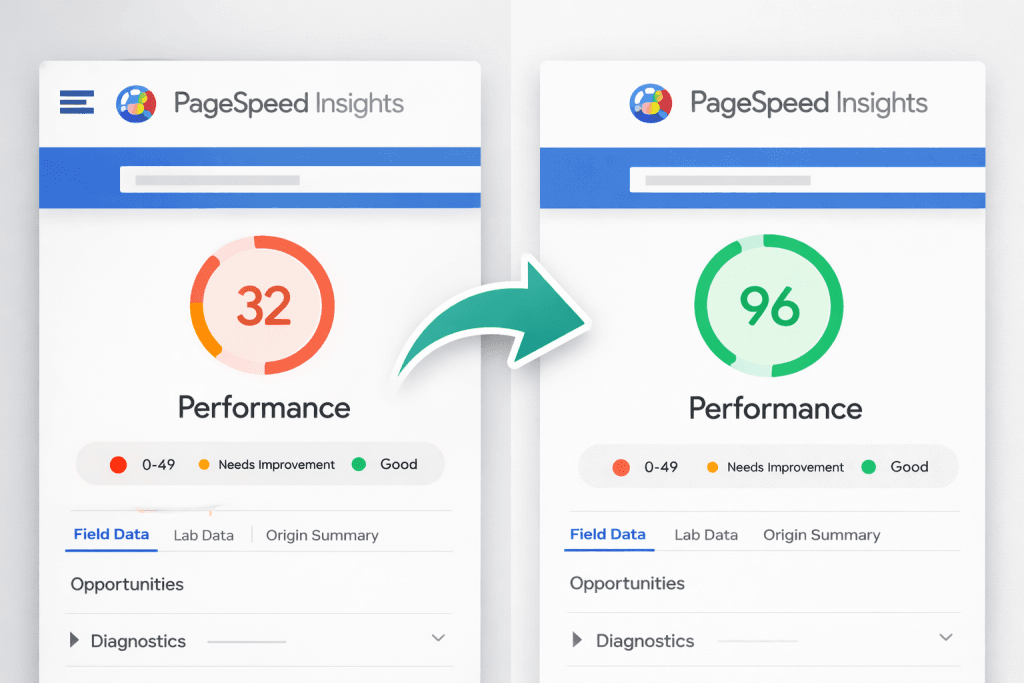
Page speed is not a technical detail. It is a commercial variable with a direct line to revenue. Google’s Core Web Vitals, which measure loading performance, visual stability, and interactivity, are both a ranking factor and a proxy for user experience quality. A website that fails Core Web Vitals thresholds is being penalised in organic search at the same time that it is frustrating the users who do manage to find it.
Research from Google confirms that 53% of mobile users will abandon a page that takes more than three seconds to load (Google, Think with Google). Given that mobile devices now account for the majority of web traffic in most industries, this is not an edge case. It is the primary use case, and it deserves to be treated as such.
A redesign that produces a visually impressive website with poor Core Web Vitals scores has traded one problem for another. Performance optimisation needs to be built into the technical specification before development begins, not addressed as a remediation task after the site has gone live. This means image compression and next-generation formats, font loading strategies, efficient JavaScript delivery, server response time standards, and hosting infrastructure choices that support the performance requirements of the final product.
Performance Reality Check
A redesign that produces a visually impressive website with poor Core Web Vitals scores has traded one problem for another. Performance targets need to be defined in the brief before the first wireframe is drawn, not optimised after development is complete.
When a Full Redesign Is Not the Right Answer
Not every business problem that manifests on a website requires a complete redesign. In many cases, a full redesign is the highest-risk and most expensive way to solve a problem that could be addressed more precisely and with better outcomes through targeted, data-led optimisation.
A business experiencing low conversion rates on a specific page does not necessarily need a new website. It may need a restructured page hierarchy, clearer calls to action, faster load times, and revised copy tested against real user behaviour. A business losing organic visibility may need a content and technical SEO programme, not a new design system. The key is to diagnose before prescribing, and to match the scale of the intervention to the scale of the problem.
Continuous improvement programmes, sometimes called conversion rate optimisation (CRO) engagements, frequently deliver better commercial outcomes than periodic complete redesigns precisely because they are iterative, data-driven, and reversible. Changes are tested against control versions of existing pages before being deployed permanently. This removes the catastrophic failure mode that complete redesigns are vulnerable to.
A full redesign is the right answer when the existing site has fundamental structural problems that cannot be solved incrementally, when the brand or positioning has changed significantly enough that the current site actively misrepresents the business, or when the technical debt in the existing platform is so substantial that it constrains what the team can build and test. Outside of those circumstances, the default should be scepticism toward the full redesign and rigour toward targeted optimisation.
The Seven Most Expensive Redesign Mistakes
After working across dozens of website and digital product projects, these are the mistakes that appear most consistently, and cost the most to fix after the fact.
| # | Mistake | What It Looks Like | The Real Cost |
|---|---|---|---|
| 1 | No baseline data before starting | Commissioning a redesign without knowing current traffic, conversion, or bounce metrics | No way to measure ROI; no ability to identify what actually improved |
| 2 | Aesthetics over architecture | Approving visual direction before information architecture and user journeys are defined | Beautiful pages that users cannot navigate and search engines cannot index effectively |
| 3 | SEO migration left to chance | Launching without 301 redirects, URL mapping, or post-launch monitoring in place | Months or years of organic search equity lost in days; revenue drops that take quarters to recover |
| 4 | No user research | Redesigning based on stakeholder preference rather than user behaviour data | Removing features users rely on; disrupting proven conversion pathways |
| 5 | Performance treated as optional | No Core Web Vitals targets in the brief; performance addressed after launch | Google ranking penalties and high bounce rates from the day the site goes live |
| 6 | Scope set by opinion, not data | Redesigning the entire site when only specific pages are underperforming | Unnecessary spend, extended timelines, and risk exposure across the entire site |
| 7 | No post-launch plan | Treating launch as the end of the project rather than the beginning of the performance cycle | Issues go undetected; no structured process to iterate and improve on live data |
How to Choose the Right Partner
The agency selection process deserves as much scrutiny as the brief itself. The most expensive mistake a business can make in a redesign is choosing a partner based primarily on portfolio aesthetics rather than process rigour and commercial alignment. Here is what separates an agency that will deliver commercial outcomes from one that will deliver a beautiful presentation and a difficult post-launch experience.
-
1
They ask about your business goals before visual preferences
An agency that jumps to design direction before understanding the commercial problem has revealed something important about its priorities.
-
2
They have a documented discovery process with written outputs
If they cannot show you what that process looks like and what it delivers, the discovery process does not exist in any meaningful form.
-
3
They have a clear SEO migration methodology
They can articulate specifically how organic search authority will be protected through the transition. This is non-negotiable.
-
4
They define performance standards upfront
Core Web Vitals targets, load time benchmarks, and hosting specifications should be part of the technical scope, not afterthoughts.
-
5
They can show you sites that perform commercially, not just look impressive
Ask for traffic data, conversion rate data, and post-launch performance metrics. An agency with genuine expertise will be able to share this.
-
6
They define what happens after launch
A website handed over without a monitoring plan, a post-launch review period, or a defined support arrangement is a project with an incomplete brief.
Practical Checkpoint
If an agency presents you with design concepts in the first meeting without having conducted any user research or site performance analysis, that is a red flag. The right process starts with understanding the problem, not selling you a solution to a problem it has not yet diagnosed.
The Bottom Line: Diagnose Before You Design
A website redesign is not an event. It is a decision with a multi-year tail, and the quality of that decision depends almost entirely on the rigour applied before any design tool is opened or any line of code is written.
The businesses that get the most from their digital investments are not the ones with the biggest budgets or the most impressive agency rosters. They are the ones that ask the right questions first, define success in measurable terms, invest in understanding their users before attempting to serve them better, and choose partners who treat the commercial outcome as the primary deliverable rather than the visual output.
If you are planning a redesign and you have not yet answered the questions outlined in this article, that is where the work should begin. Everything else follows from there.
🌐Synmek · Web Design & Development
Ready to Redesign the Right Way?
We start every project with discovery, not design. Our team diagnoses what is actually broken before we recommend a single change — so your investment goes where it creates the most return.
References & Sources
All statistics and data cited in this article are sourced from reputable industry research. We encourage readers to consult primary sources for the most current figures.
- 1. SoftwareReviews (2023). 80% of Website Redesigns Fall Short of Full Potential Due to Business-Consumer Disconnect. PR Newswire. prnewswire.com
- 2. GoodFirms (2025). Web Design Statistics: Reasons for Redesign. goodfirms.co
- 3. Forrester Research. The Business Impact of Investing in Experience. forrester.com
- 4. McKinsey & Company (2018). The Business Value of Design. McKinsey Design. mckinsey.com
- 5. Google / Think with Google. Find Out How You Stack Up to New Industry Benchmarks for Mobile Page Speed. thinkwithgoogle.com
- 6. HubSpot. Website Redesign Statistics. hubspot.com
- 7. Oracle (2011). Customer Experience Impact Report. oracle.com
- 8. Akamai Technologies. The Impact of Web Performance on Ecommerce. akamai.com
- 9. Stanford Web Credibility Research. Web Credibility Guidelines. credibility.stanford.edu
- 10. ThrillX Design (2025). Why Most Redesigns Fail and How to De-Risk Your Investment. thrillxdesign.com