

Here is an admission you do not often hear from an agency: sometimes a freelancer is the right choice, and we tell prospective clients exactly that. Roughly one in five enquiries we receive would be better served by a good independent developer, and pretending otherwise helps nobody.
But the reverse is also true. Some of the most painful projects we rescue started as a well-intentioned freelance engagement that outgrew one person. So if you are about to hire a WordPress developer in 2026, this guide gives you an honest framework for choosing between a freelancer and an agency, from a team that has been on both sides of the handover.
The Short Answer
Hire a freelancer when the work is well defined, fits inside one skill set, and does not carry serious business risk if it slips. Hire an agency when the project spans design, development and strategy, when deadlines are commercial commitments, or when the site is central to how you make money. Everything below is detail on that judgement.
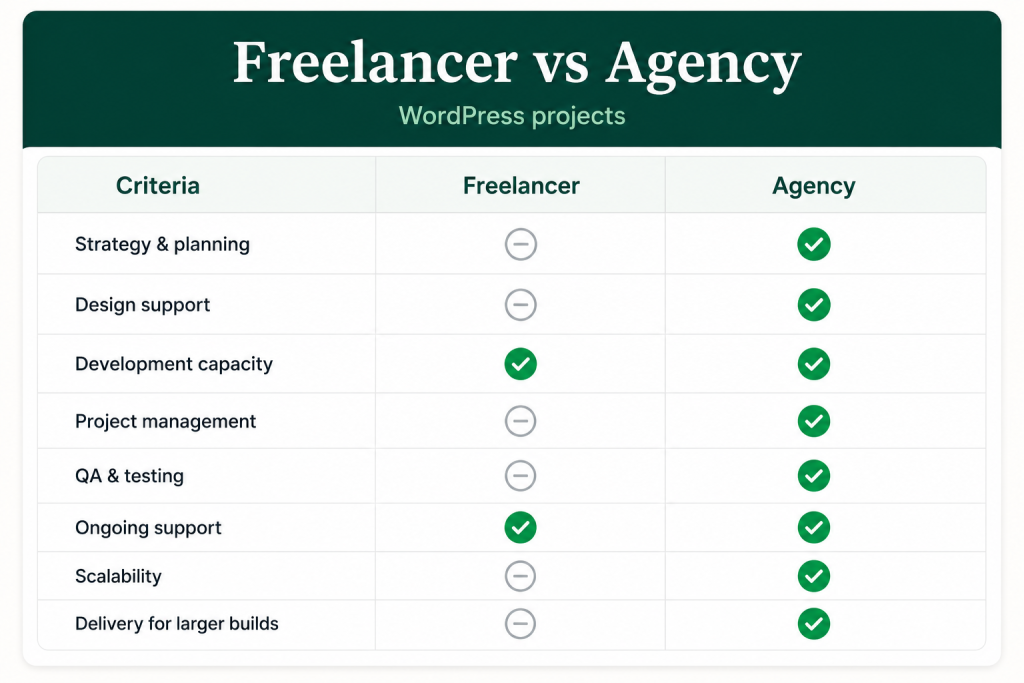
Cost: The Comparison Everyone Starts With
Freelancers are cheaper per hour. That part is simple. UK freelance WordPress developers typically charge £30 to £80 per hour depending on seniority, with YunoJuno’s 2026 report putting the average developer day rate at £438. Agencies charge roughly £75 to £150 per hour, which usually works out at £600 to £1,200 per day. We break down the full rate structure in our guide to WordPress developer rates in the UK.
The mistake is comparing hourly rates instead of total cost of outcome. A freelancer at £50 per hour who needs 120 hours, two rounds of clarification and a designer you hire separately can easily cost more than an agency’s fixed quote, and take longer. The honest comparison looks like this.
| Factor | Freelancer | Agency |
|---|---|---|
| Hourly cost | £30 to £80 | £75 to £150 |
| Design included | Rarely, hired separately | Yes, in-house |
| Project management | You are the PM | Included |
| QA and testing | Developer tests own work | Separate QA pass |
| Continuity if someone is ill or leaves | Project stops | Team absorbs it |
| Speed for small tasks | Usually faster | Process overhead |
| Accountability | Personal reputation | Contract, SLA, insurance |
| Typical sweet spot | Projects under £5k | Projects over £5k or business-critical |
When a Freelancer Is the Right Call
- The scope fits one skill set. Theme tweaks, plugin configuration, a landing page, performance fixes. One competent person can own the whole thing.
- You have technical judgement in-house. Someone on your side can review work, spot corners being cut and manage the backlog. Without that person, you are flying blind.
- Budget is genuinely tight and risk is genuinely low. If a week of slippage costs you nothing, you do not need to pay for an agency’s delivery guarantees.
- You want a long-term, part-time relationship. A retained freelancer who knows your site deeply is one of the best value arrangements in this industry. Treat them well.
When an Agency Earns Its Premium
- The project spans disciplines. Strategy, UX, design, development, SEO migration, content. Coordinating four freelancers is a full-time job, and the gaps between them are where projects die. We covered how those gaps sink projects in why most website redesigns fail.
- The deadline is a business commitment. Product launches, funding rounds, seasonal peaks. An agency has bench strength; a freelancer has a calendar and a flu season.
- The site makes you money directly. For WooCommerce stores and lead-generation sites, downtime and bugs have a price per hour. Structured QA and support SLAs exist for exactly this. See how we handle store builds on our ecommerce development page.
- You need the work to outlive the person who wrote it. Agencies document, version-control and code-review as standard practice, because handover between team members forces it. Our open source Thorn starter theme shows the standards we hold internally.
- Accountability matters contractually. Insurance, IP assignment, GDPR processing agreements and warranties are boring right up until you need them.
The bus factor is not hypothetical. YunoJuno’s data puts the average UK freelance contract at just 23 working days. Freelancers move on, get booked up and change careers. If your entire site knowledge lives in one head, you do not have a supplier, you have a dependency. Whatever you choose, insist on documentation and full access to your own code and hosting from day one.

The Middle Paths People Forget
This is not a binary choice. Two hybrid models work well and we see both succeed regularly.
Agency build, freelance maintenance. Get the architecture, design and initial build done by a team, then hand routine updates to a trusted freelancer with agency support on call for bigger changes. This front-loads quality where it matters most. Many of our clients run this model through our maintenance plans alongside their own contractor.
Freelance start, agency scale. Prove the concept with a freelancer, then bring in a team when the site becomes commercially serious. The one condition that makes this work: clean code and documentation from the start, otherwise the “scale” step becomes a rebuild. If you are unsure what state your current site is in, our free performance audit tool is a good first diagnostic.
What About Hiring In-House Instead?
There is a third option worth a paragraph of honesty. Glassdoor’s May 2026 data puts the average salaried WordPress developer in the UK at £36,552 per year, which sounds cheaper than either alternative until you add employer National Insurance, pension, equipment, holiday cover and the recruitment cost of finding someone good. The realistic fully loaded cost is closer to £45,000 to £55,000 for a mid-level developer.
In-house makes sense when you have a genuine 25 or more hours per week of WordPress work, indefinitely, and someone technical to manage the role. That describes publishers, membership businesses and large content operations. It rarely describes a company that needs a site built and then maintained. For most businesses, a build engagement followed by a maintenance retainer covers the same ground for a fraction of the cost, which is exactly why the freelancer versus agency question is usually the right one to be asking.
Five Questions That Reveal Quality on Either Side
- “Can I see something you built two years ago that is still running well?” Longevity is the real portfolio. Anyone can show a fresh launch.
- “Who owns the code, the hosting account and the licences?” The only acceptable answer is you. In writing.
- “What happens if you are unavailable for a month?” Freelancers should name a backup or explain their documentation. Agencies should explain team coverage.
- “How will you hand this over if we part ways?” Watch for hesitation. Professionals plan for their own replacement.
- “What would you push back on in my brief?” Anyone who says your brief is perfect has not read it. We wrote a fuller vetting checklist in our guide to choosing the right web design agency in London.
Frequently Asked Questions
Is it cheaper to hire a freelance WordPress developer or an agency?
Per hour, a freelancer is cheaper: typically £30 to £80 versus £75 to £150 for a UK agency in 2026. For multi-discipline projects the total cost often evens out once you add separate design, project management and the rework risk, so compare total project cost, not hourly rates.
When should I choose an agency over a freelancer?
Choose an agency when the project spans design, development and strategy, when the deadline is a hard business commitment, or when the site directly generates revenue and needs QA, support SLAs and team continuity.
Can I use both a freelancer and an agency?
Yes, and it often works well. A common model is an agency build followed by freelance day-to-day maintenance, with the agency retained for larger changes. The key is clean documentation and shared access so neither party blocks the other.
What is the biggest risk of hiring a freelance WordPress developer?
Single-person dependency. If the freelancer becomes unavailable, undocumented work can leave you unable to update or secure your own site. Mitigate it by requiring documentation, version control and full ownership of code and accounts from the start.
Not sure which side of the line your project sits on?
Send us the brief. If a freelancer is the better fit, we will tell you that, and what to ask them. If it is agency-shaped work, you will get a fixed quote within 48 hours.
Get an honest read on your project- YunoJuno, Contractor and Freelancer Rates Report 2026: developer day rates and average contract length. yunojuno.com/freelancer-rates-report
- Osdire, Web Developer Rates in the UK 2026: freelance and agency rate ranges.
- Glassdoor UK, WordPress Developer Salaries, May 2026 (in-house comparison). glassdoor.co.uk
- W3Techs, Usage Statistics of Content Management Systems, July 2026. w3techs.com