











Wannes Law
Law firm website design, legal content and local SEO for a Toronto practice with one licensed lawyer. We built the firm's first site in 2023. In 2026 we added an instant quote, started a guide-led SEO programme, measured every consultation booking end to end, and rebuilt the site from 19 pages to 92, so a client can see how their matter will run, and what it costs, before they call.
A lawyer who explains every step needed a website that did the same.
Wannes Law Professional Corporation is Rosalie Wannes's practice on Sheppard Avenue East in Scarborough, Toronto. She acts on home purchases, sales and refinances, wills and powers of attorney, probate, immigration, incorporations and notarial work, in English and Armenian. She runs every file herself, with an articling student and a law clerk. Her standard is simple: a client should understand every step of their matter and never wait long for an answer.
We built the firm's first website in 2023. By 2026 it had done its job and fallen behind. Fifteen of its 19 pages hadn't changed since 2023, the blog had never published a post, and every page opened the same way: a skyline, "Your Toronto Real Estate Lawyers" in the plural, and two buttons. The firm already had what most of its competitors don't: published flat fees, a lawyer clients could reach directly, and real reviews about real closings. The site hid all three. So the work ran in stages over 2026: a quote tool first, then search, then measurement, then a rebuild of the whole site around the way Rosalie actually works.
Visit wanneslaw.com →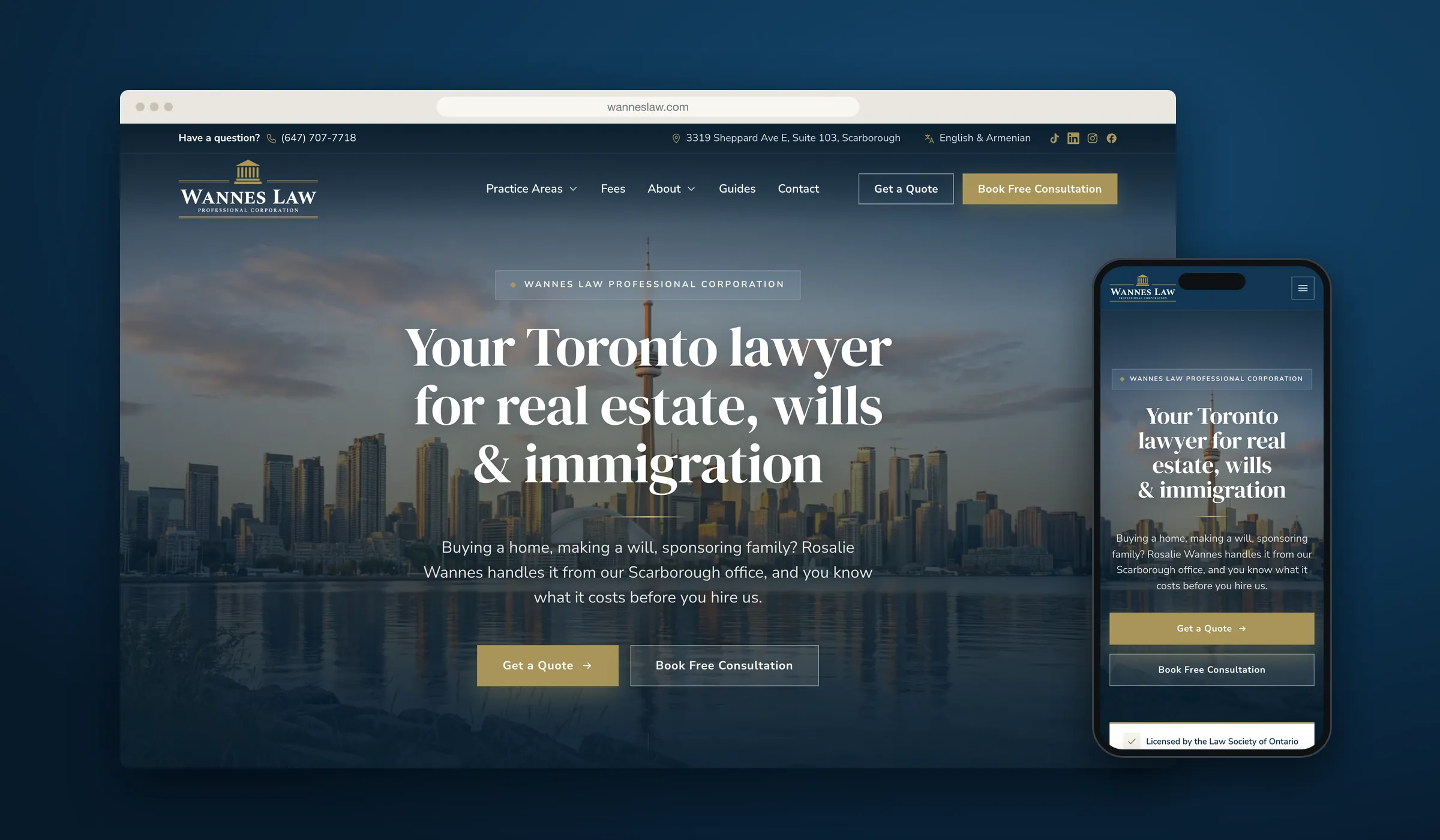
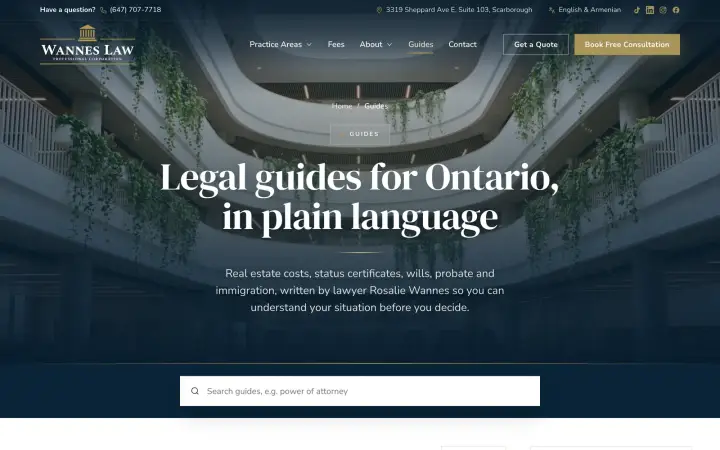
Toronto law firm websites look alike: a skyline, "experienced lawyers", seven cards. Wannes Law could show the steps and the fees instead, but its site didn't.
Five steps, each one paying for the next.
The firm's own signature on the new site is the Matter Path: every service shown as a numbered sequence. The engagement ran the same way.
-
12023
The original website
A custom WordPress theme with a page for each of the seven practice areas. It took the firm from no real web presence to a credible one, and it is the "before" in everything below.
-
2May to June 2026
An instant quote on the existing site
A four-step intake that routes each enquiry by matter type, gives a real fee where one exists and ends at the booking calendar. It was the one feature Rosalie had been asking for, so it shipped first, before any redesign.
-
3June 2026 onwards
A search baseline, then one guide at a time
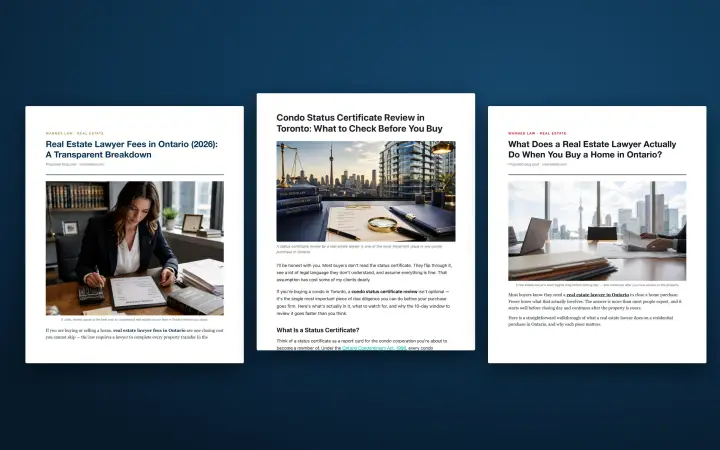
A written baseline of where the site stood, a 90-day plan, and the firm's first guides: the condo status certificate review and real estate lawyer fees in Ontario, each drafted for Rosalie to review as a PDF before it went live.
-
4July to August 2026
Every booking counted
The "Book Free Consultation" button sent people to Calendly and nothing came back. We connected Calendly to the site and to Google Analytics, so bookings, completions and cancellations are recorded wherever they start.
-
5September 2026
The rebuild
A new theme, 73 new pages and every existing page rewritten around the firm's evidence. It went to Rosalie with a 47-item legal review before launch, because a law firm's website is the firm speaking.
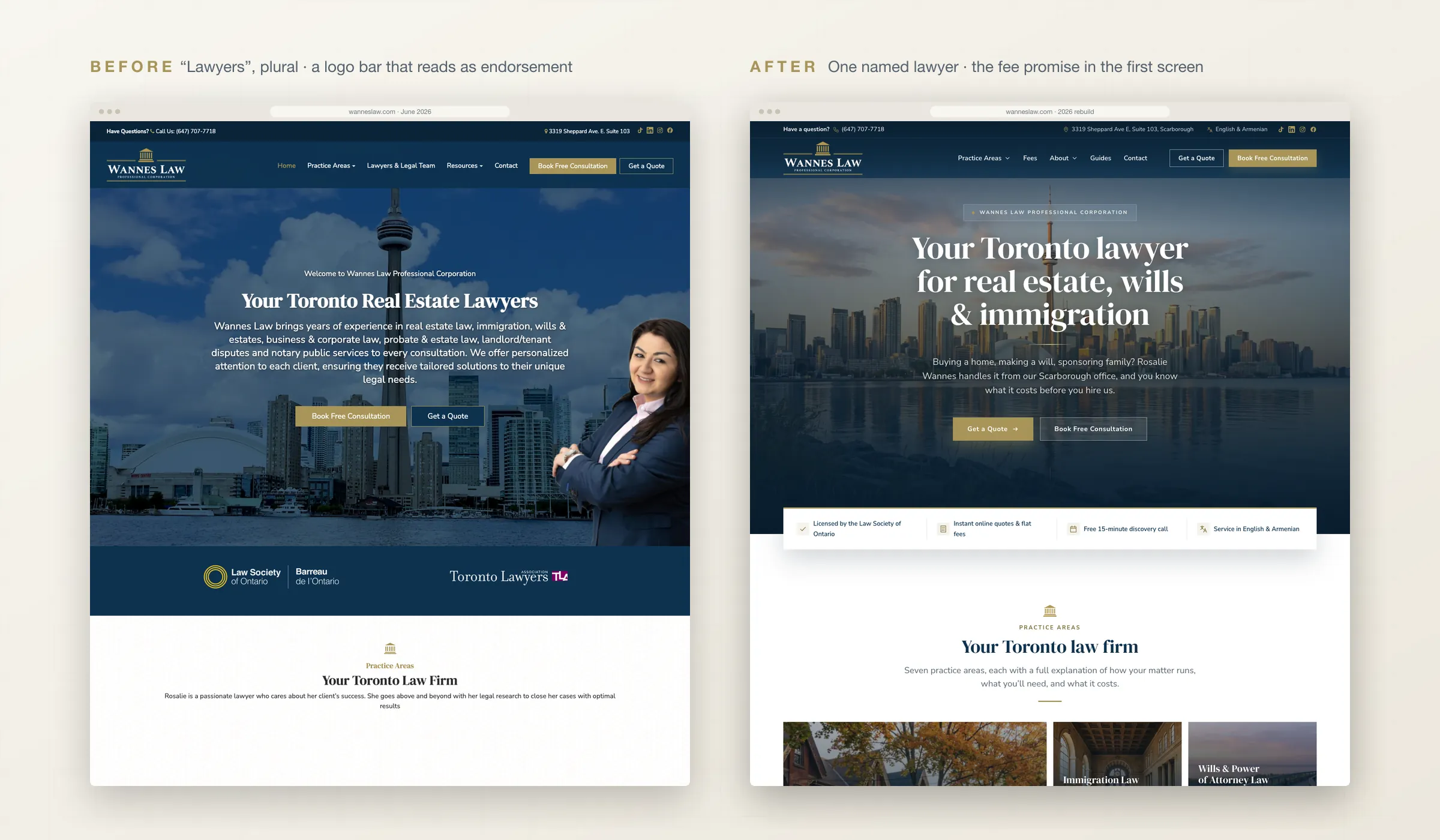
We scored the old site for how easily it could belong to someone else.
Before designing anything we audited every template, captured each key page at desktop and phone width, and scored the site on ten measures of sameness: hero, sections, cards, copy, proof, signature, mobile, calls to action, visuals and repetition. It scored 84 out of 100, where 100 is completely interchangeable. About 80% of the headings and intro paragraphs on the home, about, probate and notary pages would have survived a swap to a competitor's logo unchanged.
- Sections that stayed blankScroll-triggered fade-ins left large empty areas in every automated capture. The content was in the HTML, but anything that didn't scroll like a person saw a blank page
- "Lawyers", pluralThe firm has one licensed lawyer. The plural appeared in the main heading, the menu and across the practice pages
- Proof far from the claimSix of the eight testimonials were about real estate, yet none appeared on the real estate page. They sat in a carousel on the homepage
- An 11,105-pixel homepage on a phoneDesktop blocks stacked one under another, with the same pair of buttons every 1,500 pixels
What the new site stopped saying.
Ontario lawyers advertise under Law Society rules: marketing has to be true, accurate and verifiable, and "specialist" is a restricted word. So before writing a line, we built an evidence ledger of 34 claims the site could make, each tied to a source, and a list of the claims it couldn't. Copy that wasn't in the ledger didn't go on a page.
Where a fact needed Rosalie's word, it went on a list of open questions instead of into the copy.
"Specialize", "expert", "expertise"- Restricted by Law Society rules without certification. Replaced with what Rosalie does, step by step
"Our team of lawyers"- One licensed lawyer, supported by an articling student and a law clerk, each named in their real role
"Thousands of clients served"- No source. Taken out of the new pages and put to Rosalie in the launch review
Law Society and Toronto Lawyers Association logos- A regulator's logo can read as endorsement. Replaced by one plain line: licensed by the Law Society of Ontario
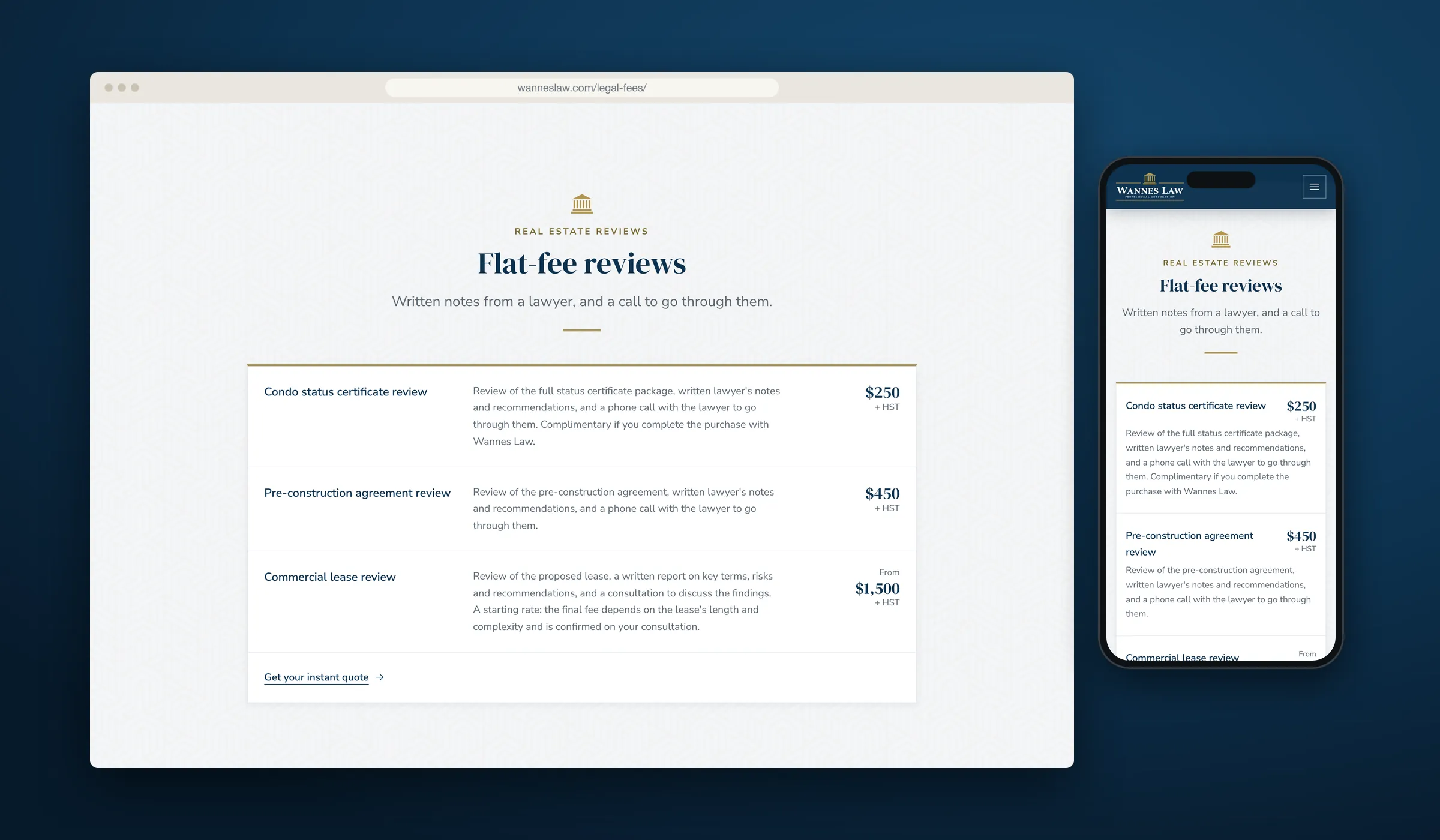
"Status certificate review $200 + HST"- The quote tool charged $250. One figure now, everywhere, with the condition that it's complimentary if the firm closes the purchase
"Unlimited access"- An absolute. Now "direct access to your lawyer and law clerk by phone and email"
Every practice page shows the matter in the order it actually runs.
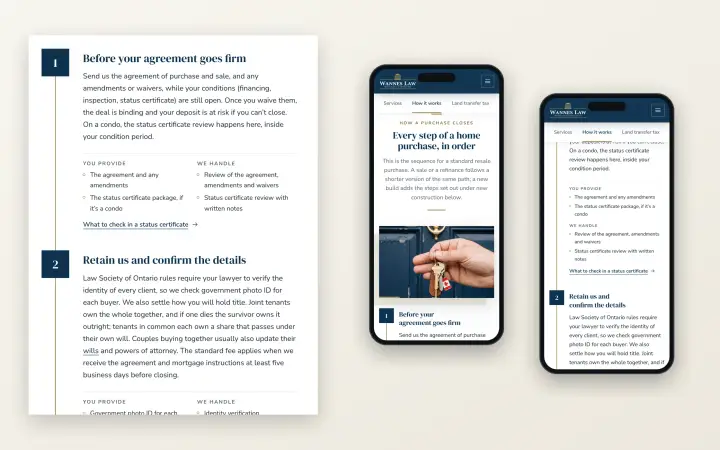
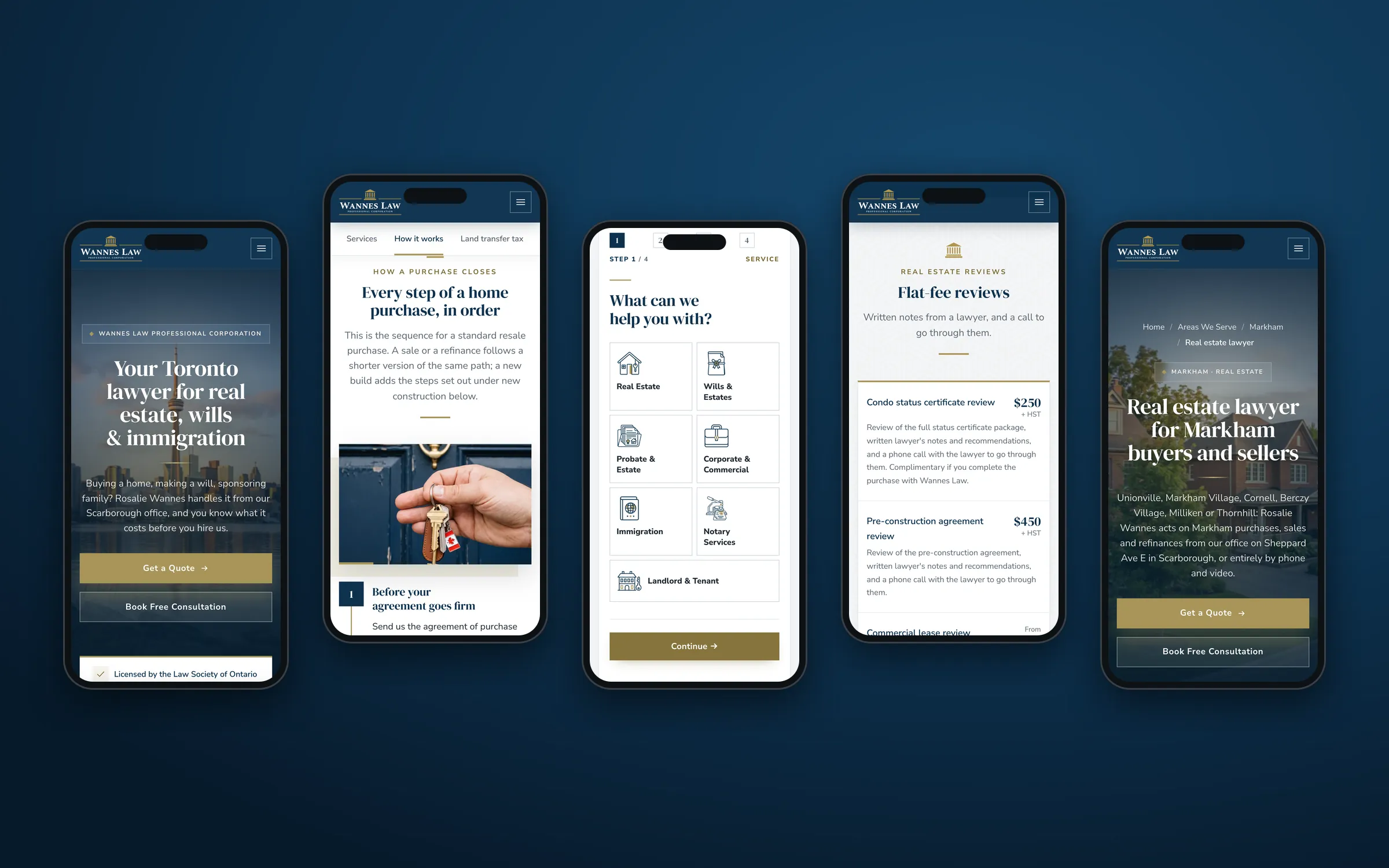
Clients of a small firm worry about the same few things. Will I be left in the dark? What do I have to bring? When could this go wrong? Rosalie's own standard answers all three, so we made it the structure of the site. Every practice and service page carries a Matter Path: numbered steps, joined by a gold line, each with what happens, what you provide, what the firm handles and where the fee sits. A home purchase has seven steps, from "before your agreement goes firm" to the reporting letter after closing.
- The risky moments namedThe status certificate inside the condition period, identity checks the Law Society requires, the requisition date, closing-day registration
- "You provide" and "We handle"Two short lists on every step, so the client knows what is theirs to do and what isn't
- Guides linked where they help"What to check in a status certificate" sits inside step one, not in a list at the bottom of the page
- Readable without JavaScriptAn ordered list with real headings. The line draws once, and is simply drawn for anyone who prefers reduced motion

Fees set out like a statement of account, with the conditions on the same line.
Clients search for fees before they search for a lawyer. Wannes Law publishes them, so the rebuild gave fees their own page and a fee statement on every practice and service page. Flat fees are shown as flat fees. Residential real estate fees depend on the price, so those pages send you to the instant quote rather than publish a ladder the Law Society's rules would make awkward. Probate, immigration and business work say plainly that they are quoted after a short call.
- One source for every figureFees live in one file and feed the fees page, the practice pages and the service pages, so a price can't disagree with itself
- Conditions in plain viewHST, disbursements, the alternative-lender surcharge and the standard-transaction conditions are written beside the fee, not in a footnote
- Everything else you pay on closingDisbursements, title insurance, adjustments, tax on mortgage default insurance and HST, each explained, so the legal fee isn't the only number a buyer understands
A legal fee and closing-cost estimate in about two minutes, without a phone call.
The quote tool was the first thing we built in 2026, on the old site, and it carried over to the new one untouched in its logic. A buyer picks the matter, enters a price and a location, and gets an itemised estimate: the firm's legal fee and HST, Ontario land transfer tax, Toronto's municipal tax where it applies, first-time buyer refunds and registration costs. Title insurance is marked as quoted at closing rather than guessed.
- Four steps: service, details, contact, bookSeven practice areas branch into their own questions, with 43 illustrated icons drawn for the options
- Real fees where they existPurchase, sale and refinance fees calculated from the firm's own schedule; flat review fees shown on the option itself
- Documents up frontUp to six files of 15 MB each, so the first conversation starts with the agreement on the desk
- Consent and spam handled properlyA privacy consent line that says no lawyer-client relationship exists until the firm confirms in writing, and Cloudflare Turnstile
- Ends at the calendarThe booking calendar is embedded on the firm's own page, so the whole route can be measured

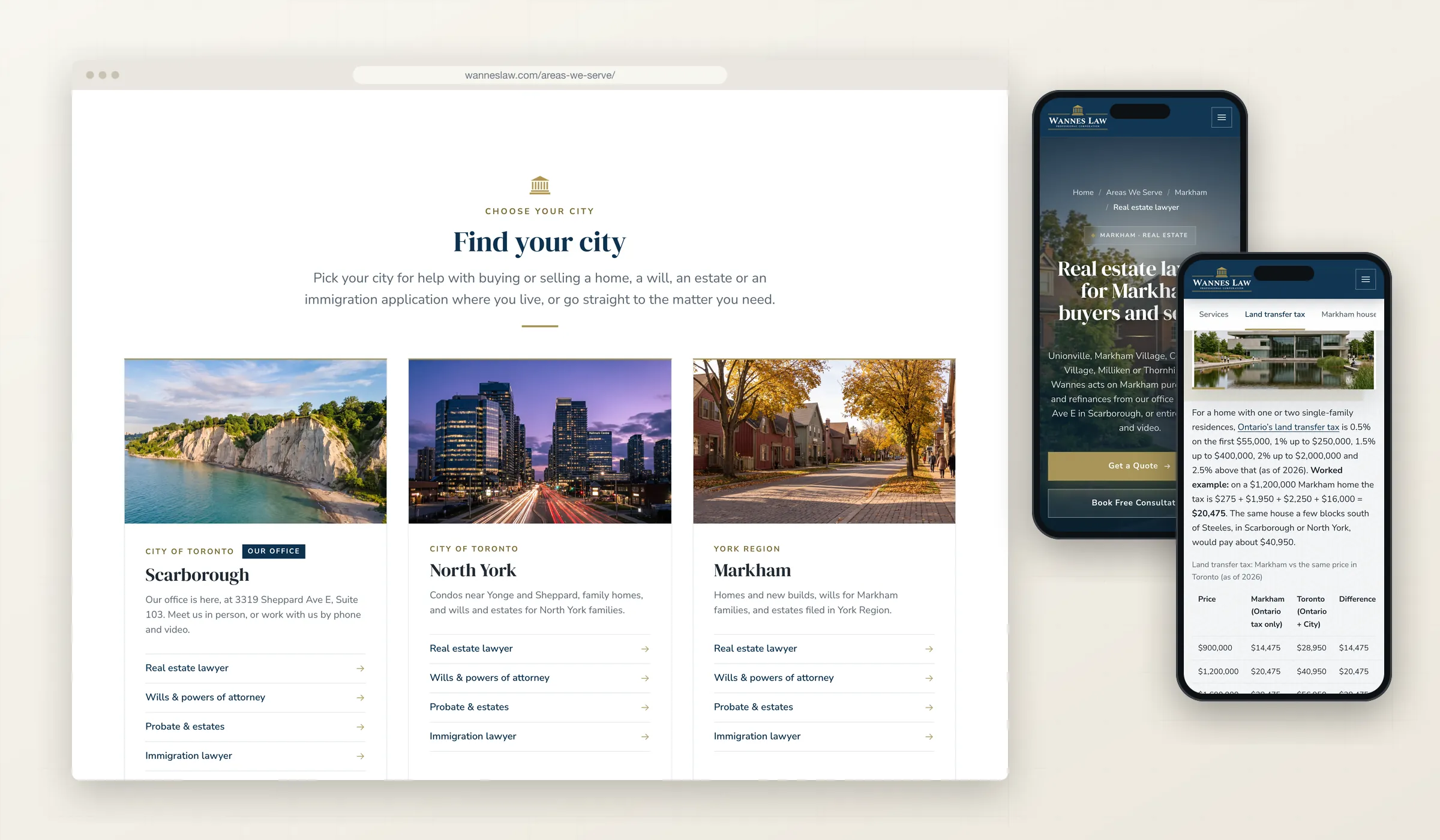
A city page is only worth publishing if it tells a Markham buyer something the Toronto page doesn't.
Eleven GTA cities, each written about the law as it applies there.
Most firms build city pages by swapping a place name into the same paragraph. Google calls those doorway pages. We wrote each one from what actually differs. A Markham buyer pays one land transfer tax, not two, and the page shows the saving at four prices. Unionville and Markham Village are heritage districts. Builders' freehold agreements register with Tarion within 45 days from April 2026. Each page names the office it is served from, Sheppard Avenue East in Scarborough, or says the work can be done by phone and video.
- 11 city pages, 46 city practice pagesScarborough, North York, Markham, Richmond Hill, Vaughan, Pickering, Ajax, Whitby, Oshawa, Mississauga and Brampton, each with real estate, wills, probate and immigration pages; Scarborough also business and notary
- Checked against official sourcesEach page lists the sources it was checked against in September 2026: ontario.ca, the city's own site, Tarion and canada.ca
- Measured for samenessShared text between any two city pages was kept at or below 12%
- No invented officesOutside Scarborough, titles read "serving Markham", never "in Markham"
From 19 pages to 92, without changing a single address.
Every URL that already ranked kept its address and its template. The 73 new pages hang off the existing ones, and the menus, breadcrumbs, footer and page creation all read from one registry.
Kept
Home, the seven practice areas, about, team profiles, quote, contact, FAQ, testimonials and the blog. Same addresses, rewritten pages.
Service pages
Buying, selling, refinancing, title transfer, pre-construction review, commercial; wills, powers of attorney; family sponsorship, work permits and LMIA, permanent residence, H&C; commissioner of oaths.
Reference pages
Legal Fees, Lawyers & Legal Team, and Areas We Serve.
Places
11 city pages and 46 city practice pages under them, each with its own title, description and focus keyphrase.

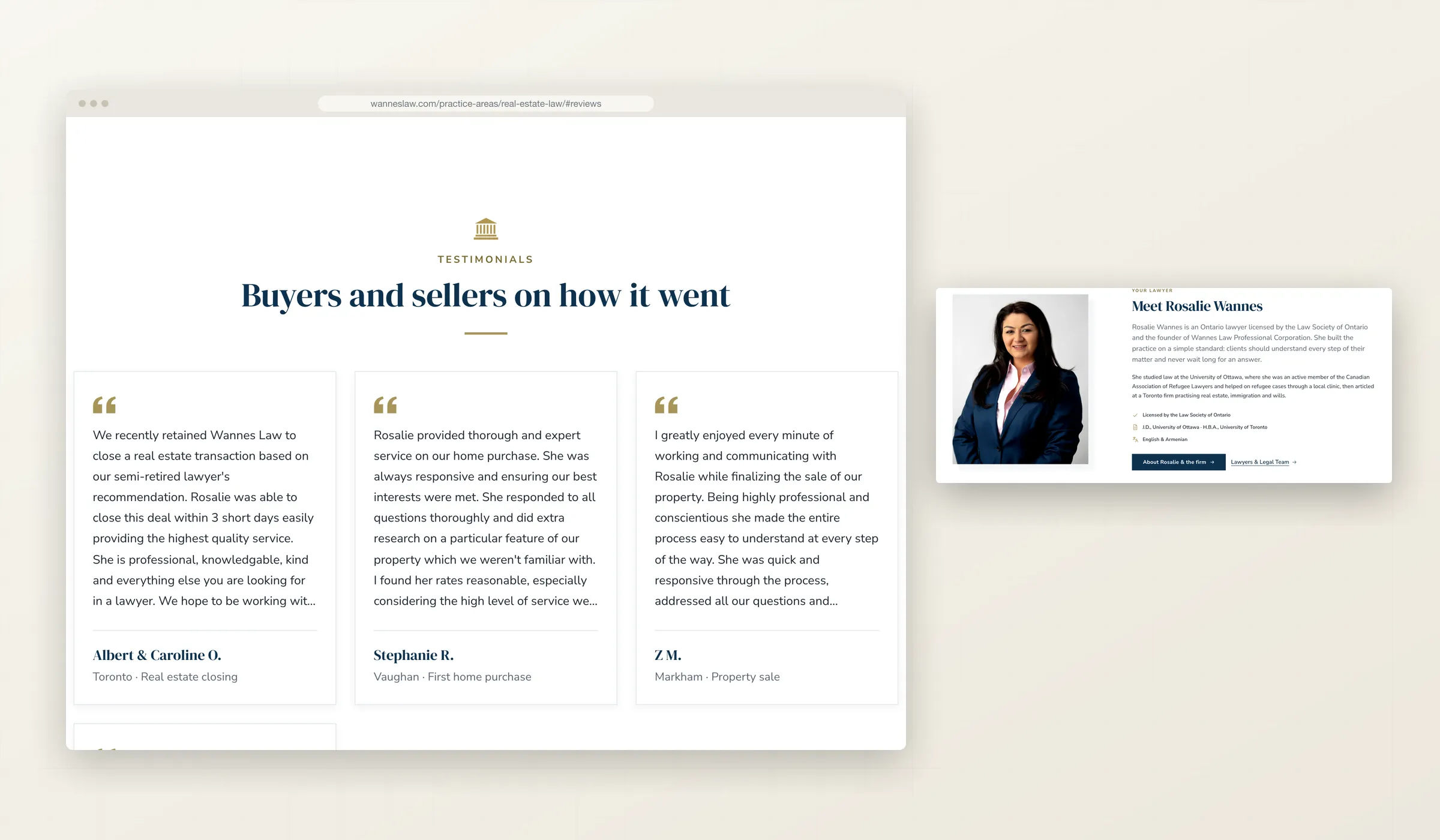
The real estate page carries the real estate reviews.
The firm's testimonials are good and specific: a first home, documents explained two days before closing, a deal closed in three days. In the old site they rotated in a carousel on the homepage. Now each one is tagged by matter and appears on the page for that matter, word for word, with first name, last initial and city. Rosalie herself appears where people decide: her portrait, her licence, her degrees and her languages, stated as facts.
- Live Google reviewsRead from the Google Places API, cached for 12 hours, with the last good copy kept if Google can't be reached
- Reviewers kept privateFirst name and last initial only; a full-name sign-off at the end of a review is removed, the review text is not
- No self-served review starsNo review markup is added to the firm's structured data
- No generated likeness of RosalieHer portrait slots use real photographs only. Generated scenes show streets and documents, never her or her office
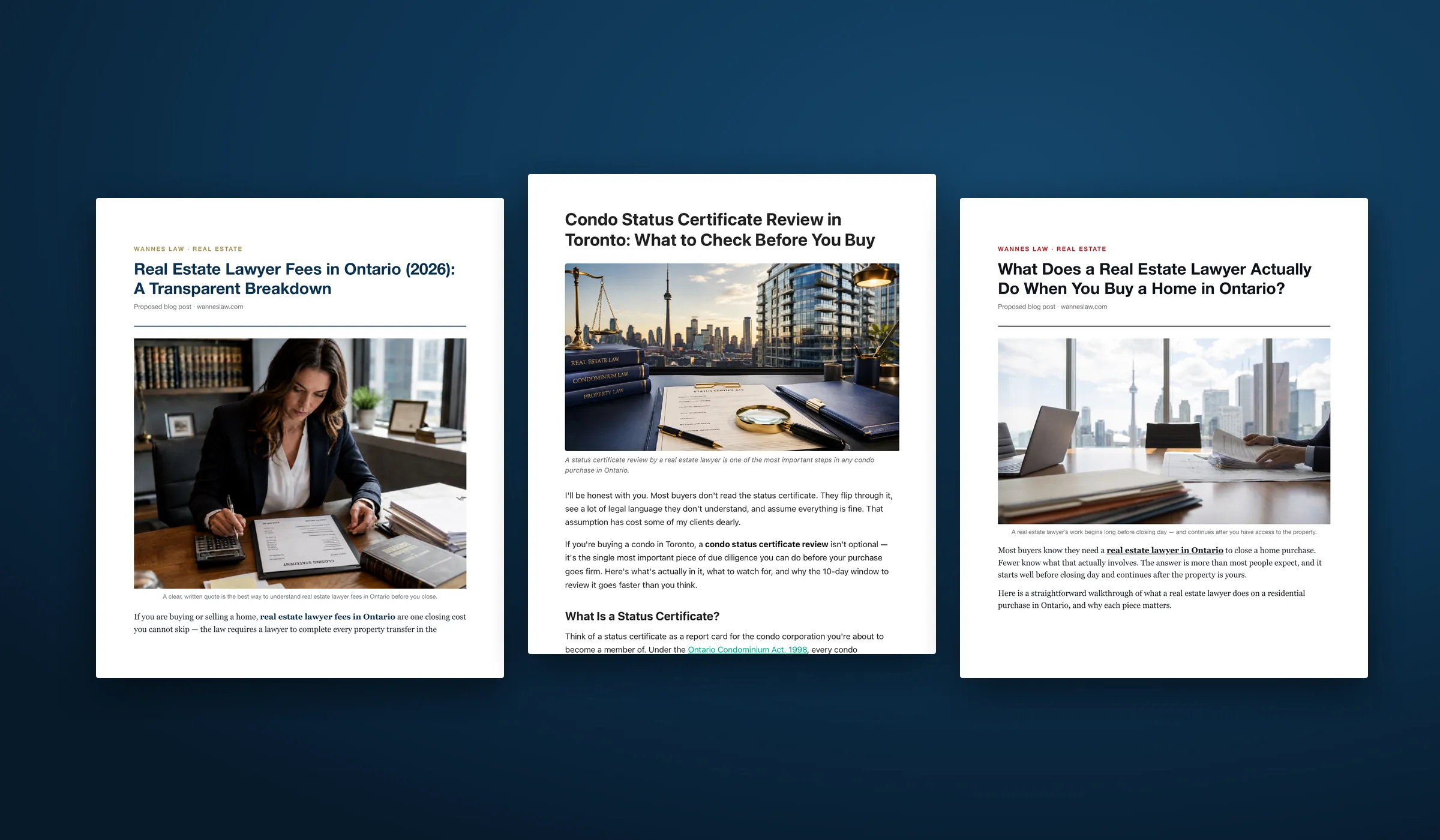
Guides written for the question in front of the client, then approved by the lawyer.
In June 2026 the blog had never published a post. The plan was one guide a month, built around one cluster: what buying a home in Ontario costs, and what the lawyer does for it. Each guide is drafted in Rosalie's voice with current figures and sources, laid out as a PDF for her to approve, then published. A guide that ranks is then linked from the practice pages, so its readers have somewhere to go next.
- Condo status certificate review in TorontoJune 2026. Averaged position 6.9 to 7.8 on Google from July to August
- Real estate lawyer fees in OntarioJune 2026. 7,281 impressions and 50 clicks in August alone
- What a real estate lawyer doesAugust 2026, indexed within the month
- Real estate lawyer disbursements, itemisedWritten for September 2026, using the fee schedule in force from November 2025
- What to do when someone dies in OntarioWritten for September 2026, the first guide outside real estate
Twenty-five people a month clicked "Book Free Consultation". Until August, nobody could say how many of them booked.
Every consultation counted, from booked to completed.
The booking button handed visitors to Calendly, and once they left the site nothing came back. We asked Calendly directly instead. With Rosalie's access token the site records each booking's whole life and sends it to Google Analytics from the server. A booking counts when a slot is confirmed, a completion when the meeting time passes without a cancellation or a no-show. That definition is written into the code, because the number means nothing without it.
- Two paths that agreeSigned webhooks report in real time; a reconciler runs every 15 minutes to sweep up anything they miss. Both write to the same row, so nothing is counted twice
- A reminder the day beforeThree of August's twelve bookings were cancelled, so each booking now gets a reminder 24 hours ahead
- A dashboard in WordPressConnection status, recent bookings, bookings by source and an export, without opening Analytics
- Off anywhere but the live siteAnalytics and indexing switch off automatically on test servers, so reviews never pollute the data
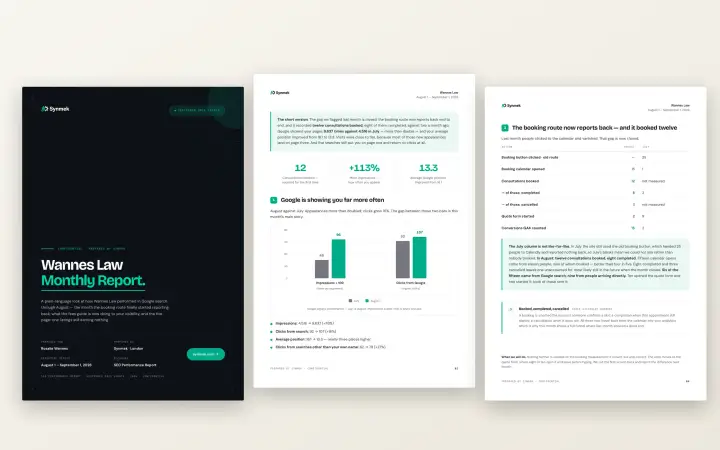
Fifteen calendar opens came from eleven people, nine of whom booked. One booking was still in the future when the month closed. In July the same route reported 25 clicks and no outcome. Source: Calendly and GA4, September 2026 report.
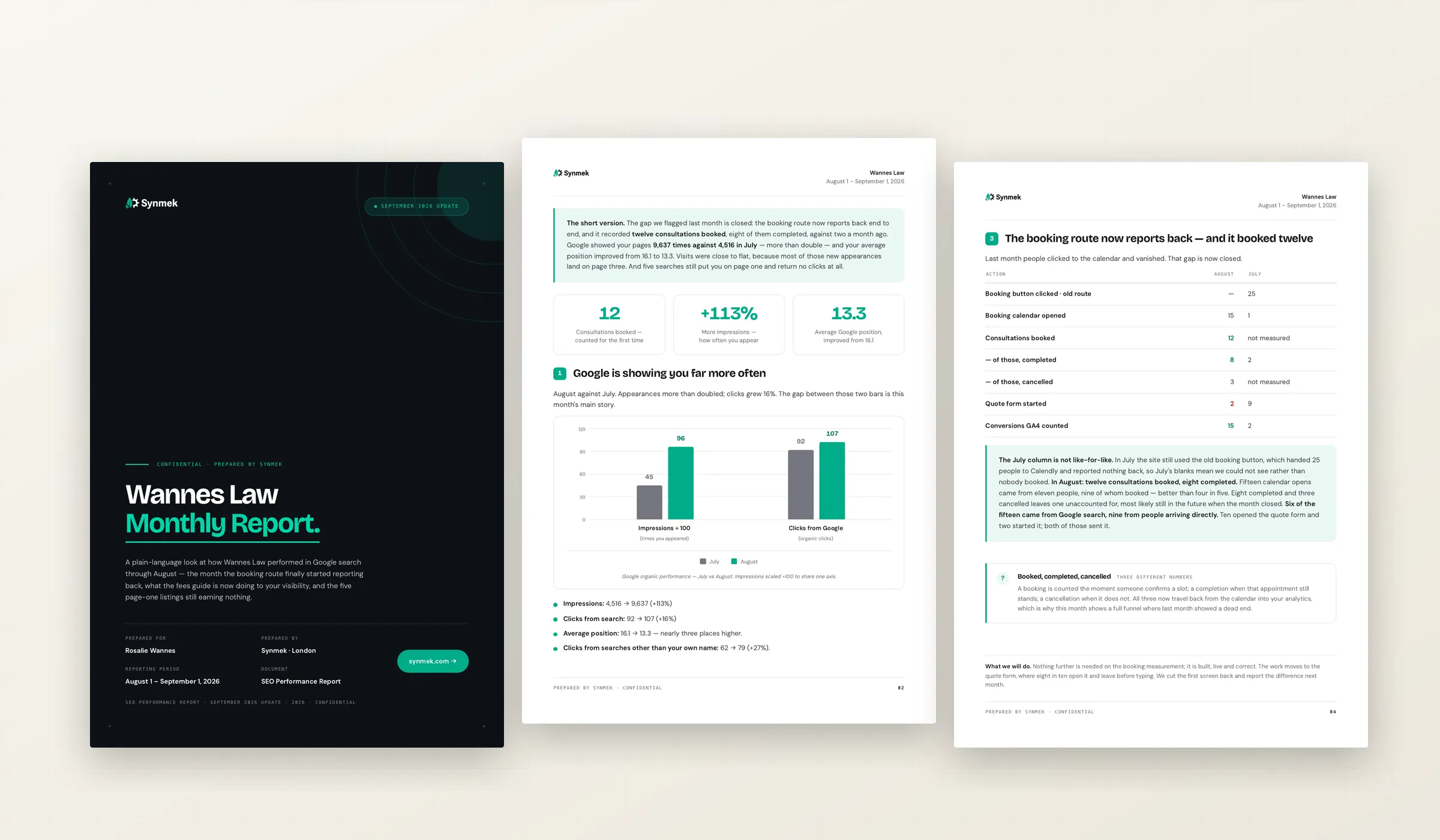
A report a lawyer can read in ten minutes, including the parts that went the wrong way.
Every month Rosalie gets a short report in plain language. It explains what the numbers mean before showing them, says when two periods can't be compared, and ends with a numbered list of what we will do next. It also names what isn't working. In September that meant the status certificate guide: on page one at position 7.8, but earning nine clicks from 1,179 appearances.
- Like for likeWhen a reporting window overlapped the last one, the report said so rather than stacking the gains
- The www duplicate, tracked to the endGoogle treated wanneslaw.com and www.wanneslaw.com as two sites. After the redirect, the duplicate's share of impressions fell from 43% in June to 5% in August
- Page-one listings with no clicksFive searches put the firm on page one in August with no visits. Rewriting those listings went to the top of the next month's list
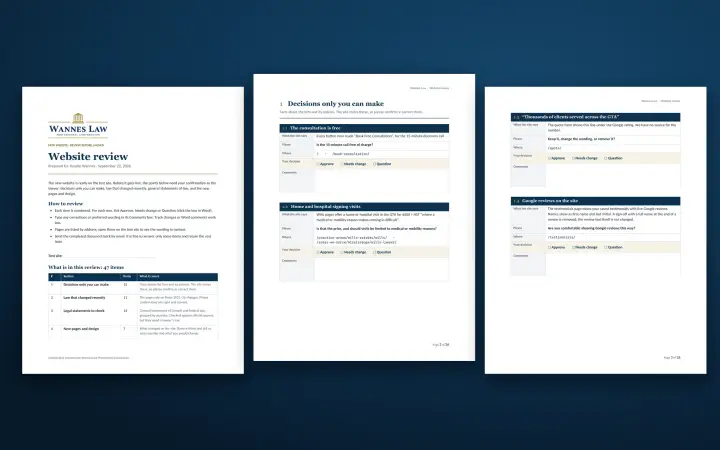
47 questions only the lawyer could answer.
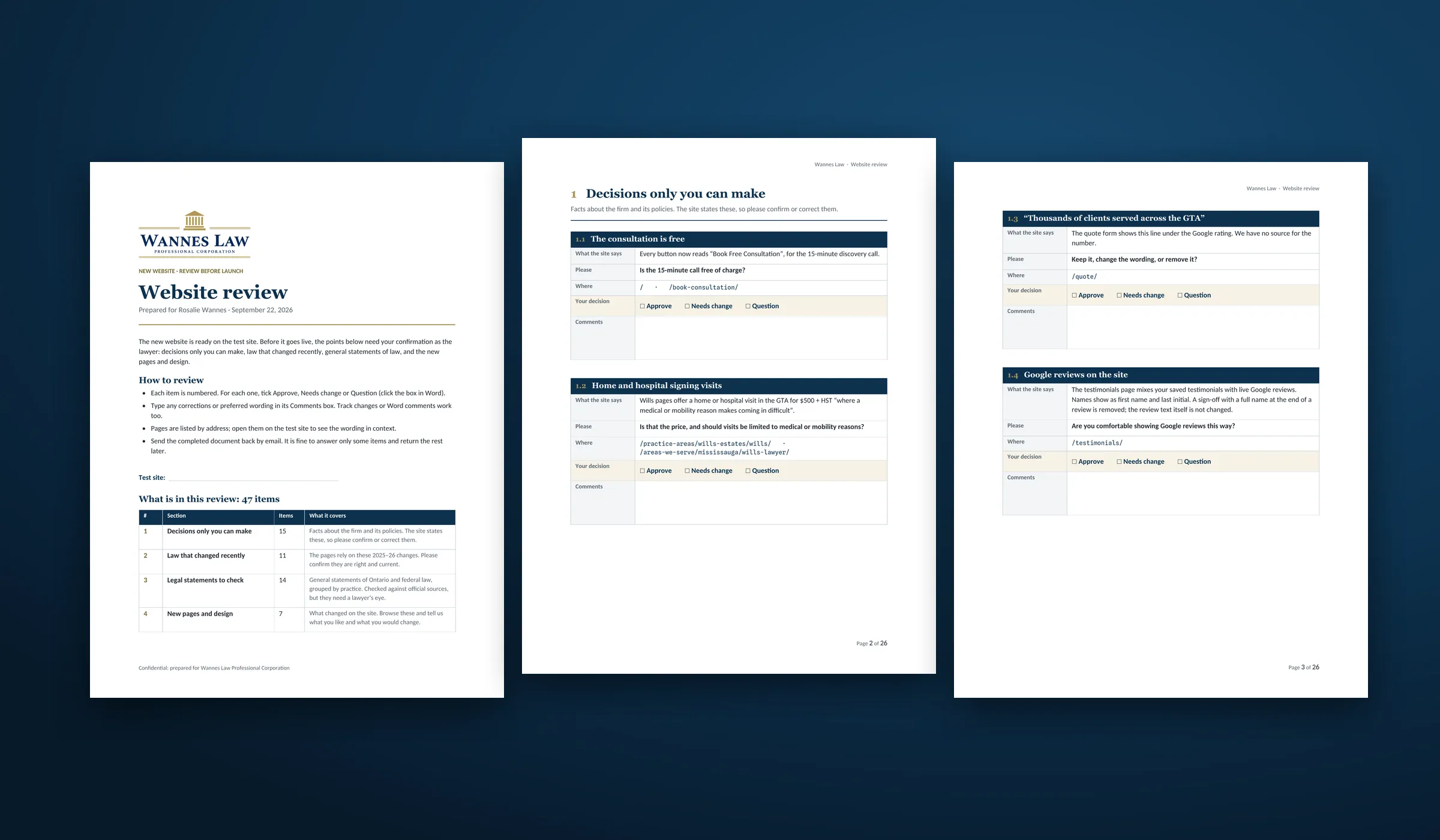
A law firm's website states the law and the firm's policies in the firm's name. So before launch we sent Rosalie a review document in Word, one item per decision, each with what the site says, the question, the pages it appears on and boxes for Approve, Needs change or Question. She can answer some now and the rest later.
- 15 decisions only she can makeIs the 15-minute call free? Is landlord and tenant work referral only? Keep "thousands of clients"? Generated photographs?
- 11 changes in the law from 2025 and 2026Landlord and Tenant Board changes, the paused parents and grandparents program, new-home rules, Toronto's land transfer tax
- 14 groups of legal statementsReal estate, wills, probate, immigration, business and notary, each checked against official sources and then put in front of a lawyer
- 7 design questionsCity pages, rewritten practice pages, testimonials, the quote form, the phone layout and links on blog posts
Built so the content can be checked, and the launch can't break what already ranks.
The theme is hand-built on Synmek Thorn with no page builder. Page copy lives in versioned files, one per practice, service and city page, so every legal statement can be reviewed in a diff. Launch is a plugin that knows which site it's on: on a fresh test server it builds the whole site, and on wanneslaw.com it only adds the 73 new pages and changes nothing that exists.
- A title, description and focus keyphrase for every new pageTitles under 60 characters and descriptions under 155, written into Yoast by the launch plugin
- Structured dataLegalService on every practice, service and city page, linked to one firm record, plus FAQPage markup that matches the questions on the page
- No address changedAll 19 existing URLs and templates kept, and redirects for old blog slugs
- Every section has its imageScenes of real GTA streets and the objects of each matter, in WebP at three widths, with alt text describing the matter
- Strategy files never shippedThe build excludes the project's research folder, so the evidence ledger can't become public by accident

A page for each matter, written for the person who has it.


Measured like a statement of account: each figure with its period and its source.
Sources: Google Search Console and GA4 for wanneslaw.com, as set out in our July, August and September 2026 monthly reports. No paid advertising ran in July or August. These results come from the SEO work and booking measurement on the existing site; the rebuilt site was in Rosalie's review before launch when this was written, so none of them is credited to it. We'll add its numbers when there are enough to report honestly.
