SaaS market by 2029
Mordor Intelligence, 2024
SaaS startups fail
CB Insights / Failory, 2023
Avg. SaaS apps per org
BetterCloud, 2023
Why SaaS Architecture Is a Business Decision, Not a Technical One
Let’s start with a number that should get every founder’s attention: the global SaaS market was valued at $197 billion in 2023 and is projected to grow to $883 billion by 2029 — a compound annual growth rate of roughly 28% (Mordor Intelligence, 2024). The opportunity is real, enormous, and accelerating.
But here’s the uncomfortable truth sitting behind those numbers: 90% of SaaS startups fail. Not because their ideas were wrong. Not because the market wasn’t there. They fail because the product couldn’t scale, the codebase became unmaintainable, or the architecture couldn’t support the features the business needed to grow. Architecture debt kills SaaS companies as surely as runway depletion.
This is why architecture needs to be in the boardroom conversation, not just the engineering stand-up. Every architectural choice you make — or allow your development team to make without challenge — has direct consequences for your cost base, time to market, investor attractiveness, and your ability to hire talent. The decisions made in the first 90 days of a SaaS build shape the trajectory of the next five years.
Synmek Perspective
“The decisions made in the first 90 days of a SaaS build shape the trajectory of the next five years. Architecture isn’t a back-end concern — it’s a business strategy.”
Before we go further, it’s worth understanding what ‘SaaS architecture’ actually means in plain terms. At its core, SaaS (Software as a Service) architecture is the structural blueprint of a software product delivered over the internet — where customers subscribe to use your product rather than install it. The architecture defines how your application is built, how it stores data, how it handles multiple customers simultaneously, how it scales under load, and how it communicates between its various components.
Get it right and you have a platform. Get it wrong and you have technical debt that costs more to fix than it would have cost to build correctly in the first place.
The SaaS Market in 2026: Context That Should Shape Your Decisions
Context matters when you’re making architectural decisions. The market your product is entering, the competitive landscape, and the expectations of your target buyers all influence what ‘good enough’ looks like — and where you need to be exceptional.
| Metric | Data Point | Source |
|---|---|---|
| Global SaaS market value (2023) | $197 billion | Mordor Intelligence |
| Projected market value (2029) | $883 billion | Mordor Intelligence |
| CAGR (2024–2029) | ~28% | Mordor Intelligence |
| Avg. SaaS apps per organisation | 130+ | BetterCloud, 2023 |
| Businesses using at least one SaaS product | 99% | BetterCloud, 2023 |
| SaaS companies that fail within 3 years | ~90% | Failory / CB Insights |
| Avg. cost to acquire a SaaS customer (SMB) | £200–£1,000 | OpenView Partners, 2024 |
| Median SaaS churn rate (SMB) | 3–7% monthly | Recurly Research, 2024 |
| High-growth SaaS companies shipping daily/weekly | 74% | McKinsey Digital, 2023 |
What this data tells us is that the market is enormous and growing fast — but it is also intensely competitive. Your customers already use over 100 SaaS products. They have a baseline expectation for reliability, speed, user experience, and integration capability that gets higher every year. Your architecture either enables you to meet and exceed those expectations, or it quietly destroys any chance you had.
The Three Core Architectural Decisions Every SaaS Founder Must Make
When you’re building a SaaS product, you’ll face hundreds of technical decisions. But there are three foundational choices that underpin everything else. These aren’t decisions you can delegate entirely to a developer and walk away from — they have long-term commercial implications you need to understand.
1. Multi-Tenancy: How Will You Serve Multiple Customers?
Multi-tenancy is the defining characteristic of true SaaS architecture. It’s the mechanism by which a single instance of your software serves multiple customers (tenants), while keeping each customer’s data completely isolated and secure. There are three primary models:
| Model | How It Works | Pros | Cons | Best For |
|---|---|---|---|---|
| Shared DB, Shared Schema | All tenants in one database, identified by tenant ID | Lowest cost, easiest to maintain | Riskier data isolation, harder to customise per tenant | Early-stage MVPs, budget-constrained builds |
| Shared DB, Separate Schema | One database, separate schema per tenant | Better isolation, moderate cost | More complex queries and migrations | Mid-market SaaS with compliance needs |
| Separate Database per Tenant | Dedicated database per customer | Maximum isolation and customisation | Expensive to scale, complex to manage | Enterprise SaaS, regulated industries (FinTech, HealthTech) |
The right model depends on your target market. If you’re building for enterprise or regulated industries — financial services, healthcare, legal — separate databases with robust access controls will be a procurement requirement, not a preference. If you’re building for SMBs at volume, shared schema with proper row-level security is the pragmatic choice that keeps your infrastructure costs manageable at scale.
2. Monolith vs Microservices: Don’t Let the Tech Press Fool You
Ask any engineer in 2026 how to build a SaaS product and half of them will say ‘microservices’ without blinking. They’re not wrong — but they’re not entirely right either, and this distinction has cost many early-stage startups months of wasted runway.
- A monolithic architecture — where the entire application is a single deployable unit — is significantly faster to build, easier to debug, and cheaper to run in the early stages.
- Microservices architecture — where the application is broken into small, independently deployable services — is more resilient and scalable at volume, but introduces enormous operational complexity.
- The engineering team required to operate microservices effectively is substantially larger and more expensive than what most early-stage products can justify.
- Shopify, GitHub, and Basecamp all started as monoliths and scaled to hundreds of millions in ARR before migrating selectively to service-oriented architectures.
Architectural Reality Check
Microservices are an organisational scaling solution as much as a technical one. You need them when your engineering team has grown to the point where independent deployment and team autonomy are genuine productivity problems. Most early-stage SaaS products aren’t there yet.
The pragmatic approach for most SaaS MVPs and Series A products is a modular monolith — a single deployable application with clearly defined internal module boundaries. This gives you the development velocity of a monolith with the optionality to extract services later when you actually need to. Netflix, Amazon, and Uber all started this way. The key is writing clean, decoupled code from the beginning rather than letting the monolith become a ‘big ball of mud.’
3. Cloud Infrastructure: Where Your Product Lives
In 2026, almost all new SaaS products are built on public cloud infrastructure. AWS, Azure, and Google Cloud collectively hold over 65% of the global cloud infrastructure market (Synergy Research Group, 2025). The real decision is how you deploy and manage your infrastructure:
- Platform-as-a-Service (PaaS): Services like Railway, Render, or AWS Elastic Beanstalk abstract the infrastructure layer. Faster to deploy, lower operational overhead, but less control and potentially higher cost at scale.
- Container-based: Docker + Kubernetes gives you maximum portability and control. Industry standard for scaling SaaS products. Requires strong DevOps capability.
- Serverless: AWS Lambda, Vercel Edge Functions, Cloudflare Workers. Excellent for event-driven workloads and micro-SaaS products. Can become complex and expensive at scale.
For most SaaS products through to Series A, a containerised deployment on AWS (ECS or EKS) with managed services for databases (RDS), caching (ElastiCache), and queuing (SQS) is the gold-standard setup that balances operational simplicity with scalability.
The Modern SaaS Tech Stack: What to Build With in 2026
The technology choices you make have real commercial consequences — for hiring, for speed of development, for the ecosystem of third-party integrations available to you, and for your ability to attract investment. Here’s a pragmatic breakdown of the components that make up a production-ready SaaS product:
| Layer | Recommended Options | Why It Matters |
|---|---|---|
| Frontend Framework | React Next.js Vue | React dominates the talent pool. Next.js adds SSR for SEO and performance. Non-negotiable for customer-facing SaaS. |
| Backend / API | Node.js + TypeScript FastAPI Rails | TypeScript across the stack reduces context-switching. Rails is still the fastest way to get an MVP running if you have Ruby talent. |
| Database (Primary) | PostgreSQL | The default choice. Mature, reliable, excellent JSON support for semi-structured data. Hosted via RDS or Supabase. |
| Database (Cache) | Redis | Session management, rate limiting, real-time features. Managed via ElastiCache or Upstash. |
| Authentication | Auth0 Clerk Supabase Auth | Auth is not a competitive advantage — don’t build it from scratch. SSO, MFA, and SAML are enterprise deal-breakers if absent. |
| Payments | Stripe | The de facto SaaS billing standard. Subscriptions, usage-based pricing, invoicing, and tax compliance — all handled. |
| Resend Postmark SendGrid | Transactional email reliability is critical for onboarding. Use a dedicated provider from day one. | |
| Monitoring | Datadog Sentry PostHog | You cannot improve what you cannot measure. Instrument from day one. |
| CI/CD | GitHub Actions CircleCI | 74% of high-growth SaaS companies deploy daily. Manual deployments won’t scale. |
The principle underlying every choice in this table is the same: use proven, well-supported tools with strong ecosystems, and only build custom when you have a genuine competitive reason to do so. Every line of custom code you write is a liability as much as it’s an asset. Build the minimum viable infrastructure and spend your engineering budget on the features that create real differentiation.
Security, Compliance & Enterprise Readiness
Enterprise SaaS sales increasingly begin with a security questionnaire. Your architecture either answers those questions confidently or it doesn’t — and in competitive deals, the answer determines whether you proceed to a commercial conversation or get deprioritised in favour of a competitor that’s further along the compliance journey.
These are the compliance and security requirements that need to be baked into your architecture from the beginning — not bolted on later:
-
1
Data Residency & GDPR
Where is customer data stored? Can you guarantee EU data stays in the EU? A hard requirement for selling to UK and European businesses post-Brexit.
-
2
Encryption at Rest & in Transit
All data should be encrypted using AES-256 at rest and TLS 1.3 in transit. Table stakes, not a premium feature.
-
3
Role-Based Access Control (RBAC)
Enterprise buyers expect granular permission management. Build your access model correctly from the start — retrofitting RBAC into an existing data model is painful and expensive.
-
4
Audit Logging
Every material action in the platform should be logged with timestamp, user, and context. Non-negotiable for regulated industries.
-
5
SOC 2 Type II
The gold standard for US enterprise sales. Takes 6–12 months to achieve. If you’re targeting enterprise, start the journey at Series A.
-
6
ISO 27001
The European equivalent. Increasingly expected by procurement teams at FTSE 350 companies and public sector organisations.
-
7
Single Sign-On (SSO)
SAML 2.0 and OIDC integration with corporate identity providers (Okta, Azure AD). Blocking enterprise deals in 2026 by not having SSO is entirely avoidable.
According to Gartner, enterprise SaaS deals are on average 4.7× larger than SMB deals and have significantly lower churn. If your architecture can’t support enterprise requirements, you’re leaving your highest-value revenue segment on the table.
From Architecture to Launch: The Founder’s Roadmap
Understanding SaaS architecture is one thing. Translating that understanding into a shipped product with paying customers is another entirely. The gap between those two states is where most SaaS products fail — not in the boardroom or the architecture diagram, but in execution.
📘Build for the Architecture You Need at Stage 2, Not Stage 5
One of the most common and expensive architectural mistakes we see is founders speccing infrastructure for the scale they aspire to, rather than the scale they’re at. You do not need a globally distributed microservices architecture to get from zero to £100K ARR. You need clean, well-structured code deployed reliably.
Amazon’s CTO Werner Vogels has said that “everything fails, all the time” — and his point is that resilience comes from simplicity and good engineering practices, not from complexity. Build simply, instrument thoroughly, and add complexity only when data demands it.
Your MVP Is a Hypothesis, Not a Product
The purpose of an MVP is not to launch a polished product. It is to test the most critical assumptions about your business as cheaply and quickly as possible. This has architectural implications: your data model should be flexible enough to support rapid iteration, your deployment pipeline should enable daily releases, and your monitoring should give you clear signal on what users are actually doing versus what you think they’re doing.
A well-designed MVP should take 6–12 weeks to build, not 6–12 months. If your MVP is taking longer, the scope is too large — full stop. This is where a development partner with genuine SaaS experience earns its fee: in helping you make the scoping calls that keep the build lean without compromising the core value proposition.
The BuiltUp.io Example: Architecture Decisions in Practice
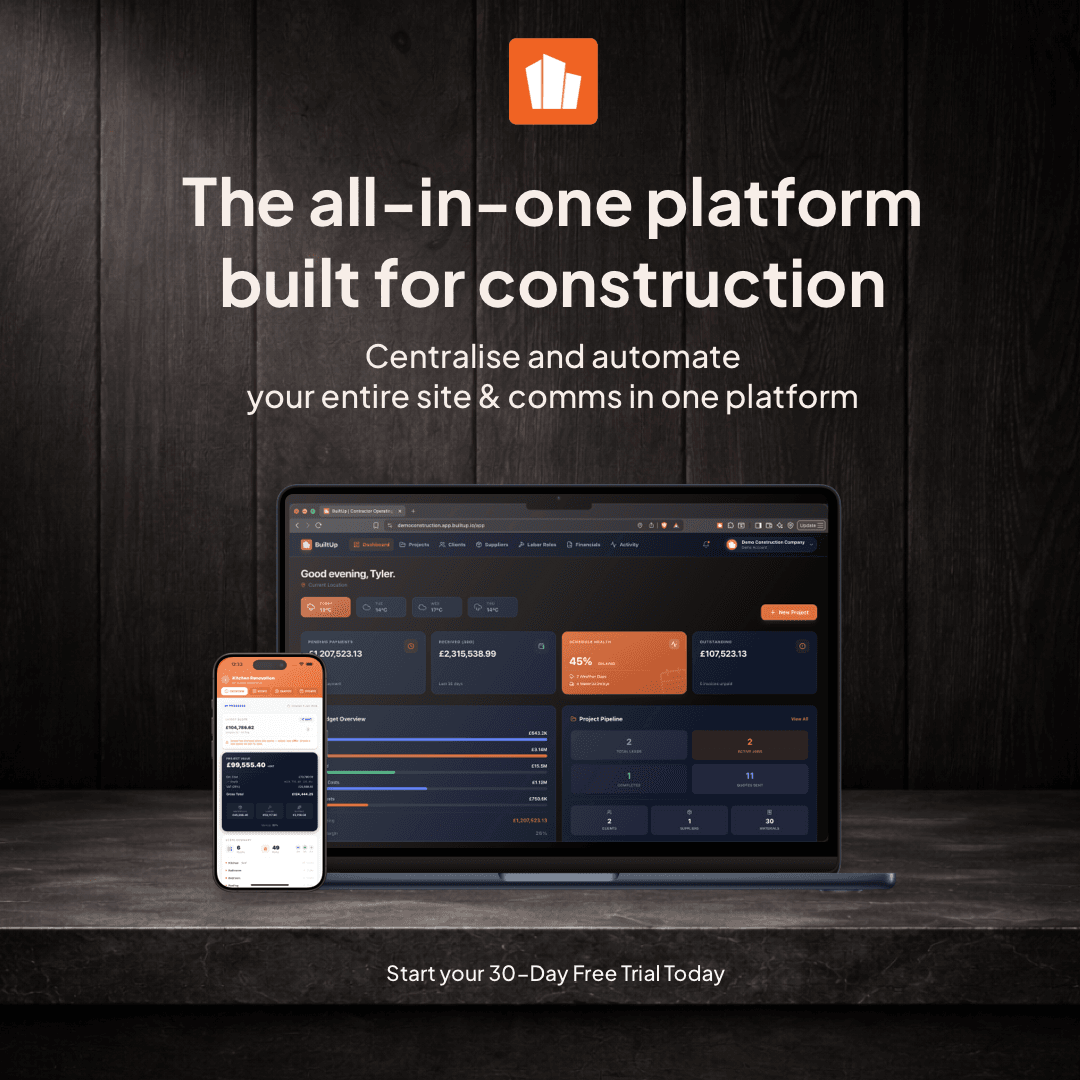
A good example of these principles in action is BuiltUp.io — a construction technology platform we took from concept to App Store. The challenge was immediately clear: construction sites are noisy, connectivity is unreliable, and the people using the app aren’t sitting at desks with fibre broadband. The architecture had to serve that reality, not ignore it.
The MVP focused on a single, solved problem — project photo management and offline access — rather than attempting to build an end-to-end construction management platform from day one. The architectural decisions that made BuiltUp viable — offline-first data sync, progressive web app architecture for cross-platform reach, and a multi-tenant mobile backend — were made during a discovery process that understood the commercial requirements, the user environment, and the technical constraints simultaneously.
🏗️The Seven Most Expensive Architectural Mistakes SaaS Founders Make
After working on dozens of SaaS products across multiple sectors, these are the mistakes we see most often — and the ones that cost the most to fix:
| # | Mistake | What It Looks Like | The Real Cost |
|---|---|---|---|
| 1 | Building features, not infrastructure | Racing to add product features without investing in CI/CD, monitoring, or data architecture | Technical debt that slows every future sprint by 30–50% |
| 2 | Choosing an obscure tech stack | Using a niche framework because it’s technically interesting | Hiring becomes a nightmare; the talent pool is tiny |
| 3 | No data strategy | Storing data without a schema, retention policies, or analytics instrumentation | Cannot make data-driven decisions; GDPR liability; investor due diligence fails |
| 4 | Auth as an afterthought | Building auth late, using a custom implementation, skipping MFA and SSO | Enterprise deals blocked; security vulnerabilities; expensive rebuild |
| 5 | Ignoring performance from day one | Not setting benchmarks, not profiling, not load-testing | Performance issues in production that are catastrophically expensive to fix |
| 6 | Wrong tenancy model for the market | Shared-schema for an enterprise market, or separate databases for high-volume SMB | Either compliance failures or infrastructure costs that destroy the unit economics |
| 7 | No rollback strategy | Deploying without the ability to roll back a broken release | Every bad deployment becomes a potential incident — a people and trust problem, not just a technical one |
How to Choose a Development Partner Who Understands Architecture
The most important hire a non-technical founder will make in the early stages of a SaaS build isn’t a CTO. It’s a development partner who can make the architectural decisions correctly the first time. Here’s what separates a partner who has genuinely built SaaS products before from one who has built websites and thinks SaaS is the same thing:
- They ask about your go-to-market strategy before they ask about your tech preferences. Architecture that can’t support the sales motion is bad architecture.
- They have an opinion on your tenancy model and can explain the commercial implications of each option.
- They talk about data modelling before UI design. The schema is the product, not the screens.
- They have a defined discovery process that produces a documented architecture decision record before any code is written.
- They can show you SaaS products they’ve shipped, not just websites they’ve launched. These are fundamentally different disciplines.
- They build in observable systems — logging, metrics, error tracking — from sprint one, not as a final task before go-live.
- They have a post-launch support model. Launching a SaaS product is the beginning of the engagement, not the end.
The economics of getting this decision right are clear. Research from McKinsey shows that tech companies that invest in strong architectural foundations grow 60% faster and deliver three times higher total shareholder returns than those that don’t. For a founder at the beginning of their SaaS journey, this isn’t an abstract statistic — it’s the difference between a product that compounds and a product that collapses under its own weight.
The Bottom Line: Architecture Is Strategy
SaaS architecture isn’t a decision you make once and move on from. It’s an ongoing series of choices — each one building on the last, each one either expanding or contracting your options for the future. The most successful SaaS founders we work with are not necessarily the most technical. They’re the ones who understand that the structural decisions made before the first sprint set the ceiling on everything that follows.
Get the architecture right and you have a platform with compounding returns. Get it wrong and you have a rebuild project waiting to happen — typically at exactly the moment your business is gaining traction and can least afford the distraction.
If you’re in the early stages of defining or building your SaaS product, our Founder’s Guide to Building a SaaS Product is the most comprehensive free resource we’ve produced on the entire journey from idea to revenue. And if you’re ready to talk about your specific product, our team is built specifically for this — we’ve designed, architected, and shipped SaaS products from pre-revenue concept through to enterprise-grade platforms.
Synmek · SaaS Development
Ready to Build Your SaaS Product?
We’ve taken products from napkin sketch to paying customers. Our team brings SaaS-specific architecture, design, and engineering under one roof — so you don’t have to coordinate three agencies.
References & Sources
All statistics and data cited in this article are sourced from reputable industry research. We encourage readers to consult primary sources for the most current figures.
- 1. Mordor Intelligence (2024). Software as a Service (SaaS) Market — Global Size, Forecast 2024–2029. mordorintelligence.com
- 2. BetterCloud (2023). State of SaaSOps 2023 Report. bettercloud.com
- 3. Synergy Research Group (2025). Cloud Infrastructure Services Market Share Q4 2024. srgresearch.com
- 4. McKinsey & Company (2023). Delivering the Tech Advantage: How Tech Investment Translates to Business Performance. McKinsey Digital.
- 5. Gartner (2024). Forecast: Public Cloud Services, Worldwide, 2022–2027.
- 6. OpenView Partners (2024). SaaS Benchmarks Report 2024.
- 7. Recurly Research (2024). The State of Subscriptions 2024: Benchmarks for Churn, Retention, and Revenue Recovery.
- 8. Failory / CB Insights (2023). SaaS Startup Failure Rate Analysis.
- 9. ISACA (2024). SOC 2 Compliance Guide for Software Companies.
- 10. Amazon Web Services (2024). Well-Architected Framework — SaaS Lens. aws.amazon.com